PAT Testing for London Furnished Lets, HMOs & Short-Let Properties
Risk-based portable appliance testing for London landlords and property managers. Document your appliance safety duty and protect yourself from liability.
Mainteniq provides PAT testing for furnished lets, HMOs, short-let properties and offices across Greater London, all 32 boroughs, from our Westminster SW1 base. Every appliance is tested and labelled, you receive a digital appliance register and certificate for the property file, failed items are reported with a recommendation, and PAT can be scheduled alongside the EICR and CP12 on one compliance visit.
Portable Appliance Testing (PAT) is the systematic visual inspection and electrical testing of mains-powered portable equipment supplied with a property. It is not a named requirement in UK statute, but landlords who supply electrical appliances with a furnished property must ensure those appliances are safe under the Electrical Equipment (Safety) Regulations 2016 (SI 2016/1101), which replaced the revoked 1994 version. Employers have a parallel duty under the Electricity at Work Regulations 1989 to maintain electrical equipment to prevent danger. PAT testing is the industry-standard method for demonstrating that both duties are being met, providing a documented, dated record of each appliance's condition. The Health and Safety Executive explicitly states that annual PAT testing is not a legal requirement, frequency should be risk-based, matched to the appliance type, usage pattern, and property turnover rate.
The Legal Reality, What UK Law Actually Says
Most PAT testing pages get the law wrong. Here is the correct position, and why PAT remains the right tool even though it is not mandated by name.
HSE's published position: “The law simply requires an employer to ensure that their electrical equipment is maintained in order to prevent danger. It does not say how this should be done or how often.”, HSE PAT FAQ
1Landlord Duty, Furnished Properties
Landlords who supply electrical appliances as part of a furnished let must ensure those appliances are safe, including at the point they are first supplied and throughout the tenancy.
Legislation: Electrical Equipment (Safety) Regulations 2016, SI 2016/1101
Note: The 1994 version of these Regulations was revoked. The 2016 Regulations apply to all appliances supplied from 8 December 2016.
Penalty: Up to £20,000 fine and/or 6 months imprisonment
2Employer Duty, Workplace Appliances
Employers must maintain all electrical systems, including portable appliances, so as to prevent danger “so far as is reasonably practicable”. There is no prescribed testing frequency, frequency must be appropriate to the risk.
Legislation: Electricity at Work Regulations 1989, Regulation 4(2)
Note: PAT is not named in the Regulations. It is the established industry method for demonstrating compliance.
Enforcement: Health and Safety Executive (HSE)
Appliance Safety Duties at a Glance
| Point | Detail |
|---|---|
| Landlord duty | Ensure all supplied electrical appliances are safe, Electrical Equipment (Safety) Regulations 2016 (SI 2016/1101) |
| Employer duty | Maintain electrical equipment to prevent danger, Electricity at Work Regulations 1989, Regulation 4(2) |
| Is PAT legally required? | No, not named in statute. It is the industry-standard method for evidencing compliance with the underlying safety duty. |
| Recommended frequency | Risk-based. Furnished lets: typically annual to biennial. HMOs and short-lets: annual or more frequent due to higher occupancy turnover. Not a legal mandate. |
| Penalty for unsafe appliances | Up to £20,000 fine and/or 6 months imprisonment under the Electrical Equipment (Safety) Regulations 2016 for supplying unsafe equipment. |
| Applies to | All mains-voltage portable appliances supplied as part of a furnished let, kettles, washing machines, TVs, lamps, extension leads, and similar. |
| HSE guidance | HSE FAQ, Portable appliance testing |
Who Should Book PAT Testing
Furnished Buy-to-Let Landlords
Any landlord supplying electrical appliances with a furnished property has a duty under the Electrical Equipment (Safety) Regulations 2016 to ensure those appliances are safe. PAT testing is the standard way of documenting that duty is met.
HMO Operators
Houses in Multiple Occupation have higher appliance turnover and more users sharing equipment. Many HMO licences specify appliance safety requirements. Risk-based PAT at shorter intervals is recommended practice.
Airbnb & Short-Let Hosts
Holiday let and short-let operators supply appliances to paying guests and retain a duty of care regardless of AST status. An up-to-date PAT record is evidence of due diligence if an appliance incident occurs.
Property Managers
Agents and managing companies acting on behalf of landlords share responsibility for appliance safety compliance. Bundling PAT into your managed portfolio simplifies scheduling and creates a single audit trail.
What PAT Testing Covers
Kettles, toasters, microwaves, and kitchen appliances
Washing machines, tumble dryers, and dishwashers
Televisions, monitors, and audio-visual equipment
Lamps, floor lamps, and portable lighting
Extension leads, power strips, and multi-socket adaptors
Electric fans, heaters, and air purifiers
Vacuum cleaners and other cleaning appliances
Charging cables and power adaptors supplied with the property
Any mains-powered equipment supplied as part of a furnished let
PAT covers portable and transportable equipment, anything that can be plugged into a mains socket and moved. Fixed electrical installation (wiring, consumer units, sockets) is assessed separately by an EICR.
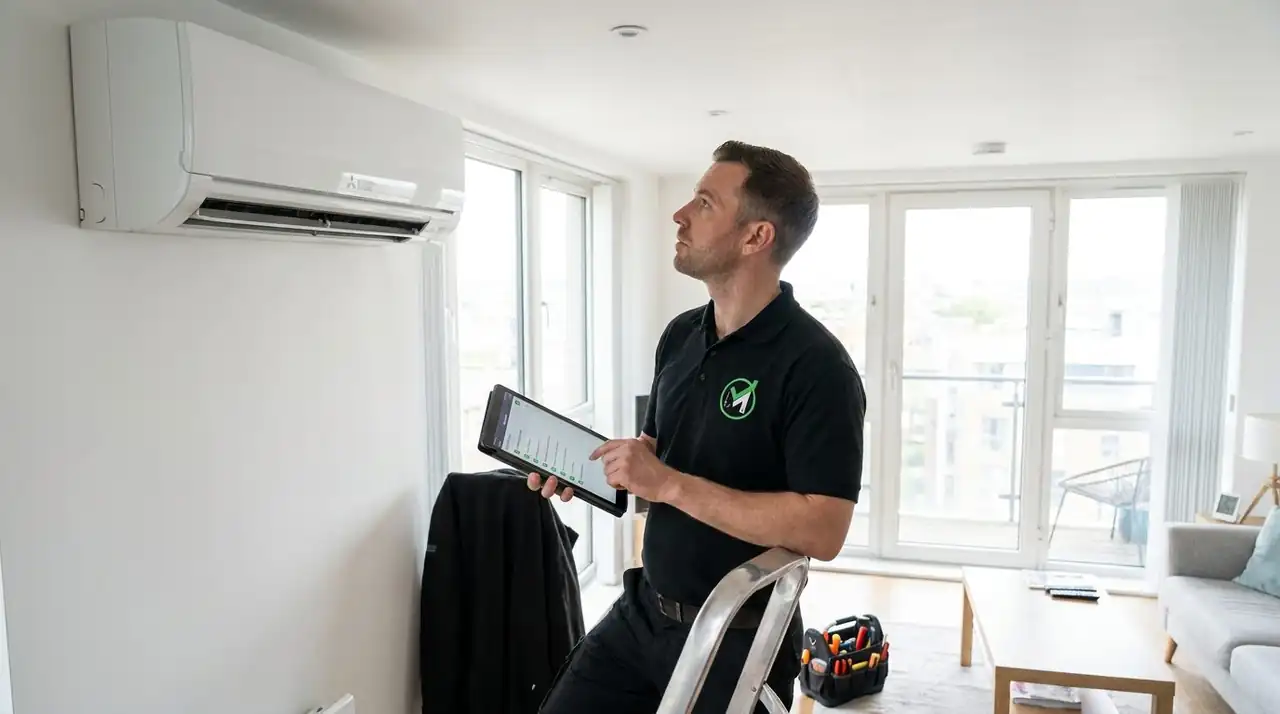
PAT as Part of Your Compliance Stack
Most PAT providers treat it as a standalone electrical service. We treat it as one layer of a landlord's full compliance obligation, scheduled alongside EICR, Gas Safety Certificate, and Legionella assessment under a single maintenance contract.
Gas Safety Certificate
Annual legal requirement for all gas appliances in rental properties.
Electrical Installation Condition Report
5-year mandatory inspection of all fixed wiring under SI 2020/312.
Portable Appliance Testing
Risk-based appliance testing, documenting your Electrical Equipment (Safety) Regs 2016 duty.
Legionella Risk Assessment
Landlord duty under the Health and Safety at Work Act 1974 for water systems in rental properties.
One contract, no gaps. Under a Mainteniq planned maintenance contract, PAT testing is scheduled alongside your EICR renewal, annual Gas Safety Certificate, and Legionella risk assessment. You get a single compliance calendar, one point of contact, and a unified audit trail, instead of managing four separate contractors and four separate reminder cycles.
How Mainteniq Delivers PAT Testing
Book via WhatsApp or phone
Tell us the property type, how many rooms are furnished, and how many appliances you estimate are in the property. We schedule at a time that suits you or your tenant.
Qualified tester attends
All portable appliances are visually inspected and electrically tested. Each item is labelled with a pass sticker and logged with a unique asset reference.
Digital register issued
You receive a full appliance register listing every item tested, its result, and the next recommended test date. Ready to retain for your compliance records.
Failed items reported
Any items that fail visual or electrical testing are flagged for replacement or repair. We advise on next steps and can coordinate electrical remedial work where needed.
Book PAT Testing for Your London Property
Serving furnished lets, HMOs, Airbnb properties and portfolio landlords across Greater London. Full appliance register issued digitally after every test.
Also need EICR, CP12, or TM44? View all compliance certificates →