How Often Should an HIU Be Serviced?
Heat interface units are the quiet workhorses of communal heating in London's blocks and build-to-rent schemes. Skip their servicing and the hot-water complaints, and the energy bills, arrive together.
If you manage a modern block or a build-to-rent scheme in London, there is a good chance the heating and hot water do not come from individual boilers at all.
They come from a communal heat network, delivered into each flat through a heat interface unit, an HIU. And the single most common question we get from managing agents and operators is a simple one: how often do these things actually need servicing?
The short answer: annually
Best practice, and the recommendation of every major HIU manufacturer, is a service once a year for each unit.
An HIU is a compact assembly of heat exchangers, valves, sensors and filters working continuously, and like any such assembly it drifts out of tune and silts up over time. An annual visit keeps it delivering to specification and catches wear before it becomes failure.
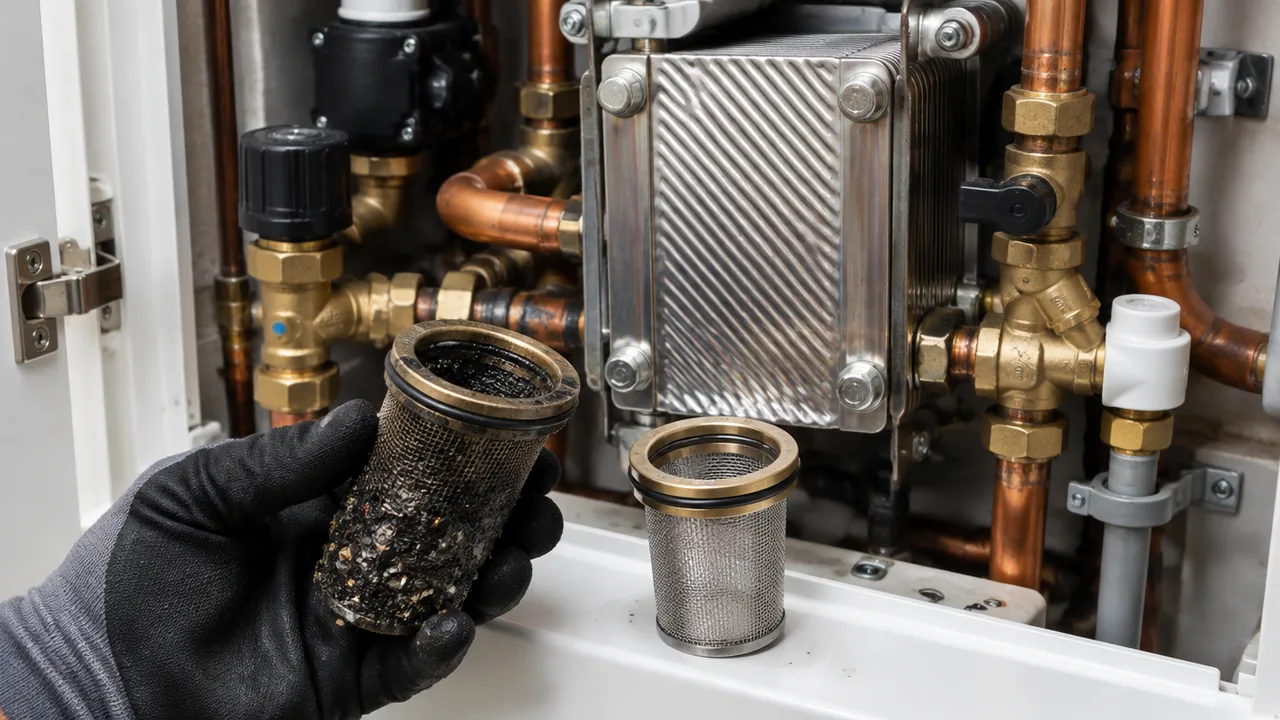
What an HIU actually does
An HIU is the bridge between the building's communal heat network and the individual flat.
Hot water circulates around the building from a central plant room; the HIU uses plate heat exchangers to transfer that heat into the flat's own heating circuit and to produce hot water on demand, without the network water ever mixing with the flat's.
It replaces the combi boiler you would find in a traditional home, which is why there is no flue, no gas supply, and no annual gas check inside the flat itself.
What a proper HIU service covers
A thorough service is more than a visual check. It should include:
- Cleaning or replacing the strainers and filters that protect the unit from debris in the network water
- Inspecting the plate heat exchangers for scaling and fouling that reduce output
- Testing the control valves and actuators that regulate flow and temperature
- Verifying temperature and differential-pressure settings against the design intent
- Checking for leaks and confirming both heating and hot water perform to specification
Crucially, the engineer should record the settings and findings for the building's maintenance log, both for accountability and because heat-network performance is increasingly scrutinised.
Why neglect is expensive, twice over
HIUs tend to be out of sight and out of mind until a resident calls to say the shower has gone lukewarm. By then the cause, a clogged strainer or a scaled heat exchanger, has usually been quietly degrading performance for months. The damage is twofold:
- Resident experience. Weak hot water and slow heating are the top drivers of complaints in communal-heating buildings, and they land on the managing agent's desk.
- Network efficiency. A poorly maintained HIU returns water to the network too hot. High return temperatures are the enemy of heat-network efficiency, they waste energy across the entire building and push up the running costs that are ultimately billed to residents.
The regulatory direction of travel reinforces this. Under the Energy Act 2023, heat networks in Great Britain are being brought under formal regulation by Ofgem, with new consumer-protection and performance expectations for operators. Documented, planned HIU maintenance is the practical foundation for meeting them.
Who is responsible?
Because the HIU is part of the communal infrastructure, responsibility for maintaining it generally sits with the building owner, freeholder, managing agent, or heat-network operator, not the individual leaseholder.
In build-to-rent schemes, the operator or agent almost always holds a single contract covering every HIU in the building, co-ordinated with the central plant and controls.
The practical approach
For a block, the efficient model is a planned maintenance contract that services every HIU on an annual cycle, alongside the plant room, pumps, and building management system that tie the network together.
Mainteniq provides exactly this across London, including the district-heating estates of boroughs like Southwark and the new-build corridors of the Isle of Dogs, and can take a scheme on from handover or from an existing provider. Our HIU maintenance service sets out what that covers.
Related services & guides
Talk to a London maintenance specialist
Whether it's one property or a portfolio, we'll put your compliance and servicing on a single planned maintenance contract. Get a no-obligation quote.