Underfloor Heating Manifold Problems: What Goes Wrong and How It Is Fixed
The manifold is where most underfloor heating faults live. That is good news: everything on it can be reached from a cupboard, so the floor almost never has to come up.
Direct answer: most underfloor heating manifold problems come from six parts: an actuator that has failed or a valve pin stuck under it, air in the manifold or loops, a pump that has seized or is set wrongly, a stuck blending valve, a weeping joint or seal, and loops that were never balanced. Each can be fixed at the manifold without lifting the floor.
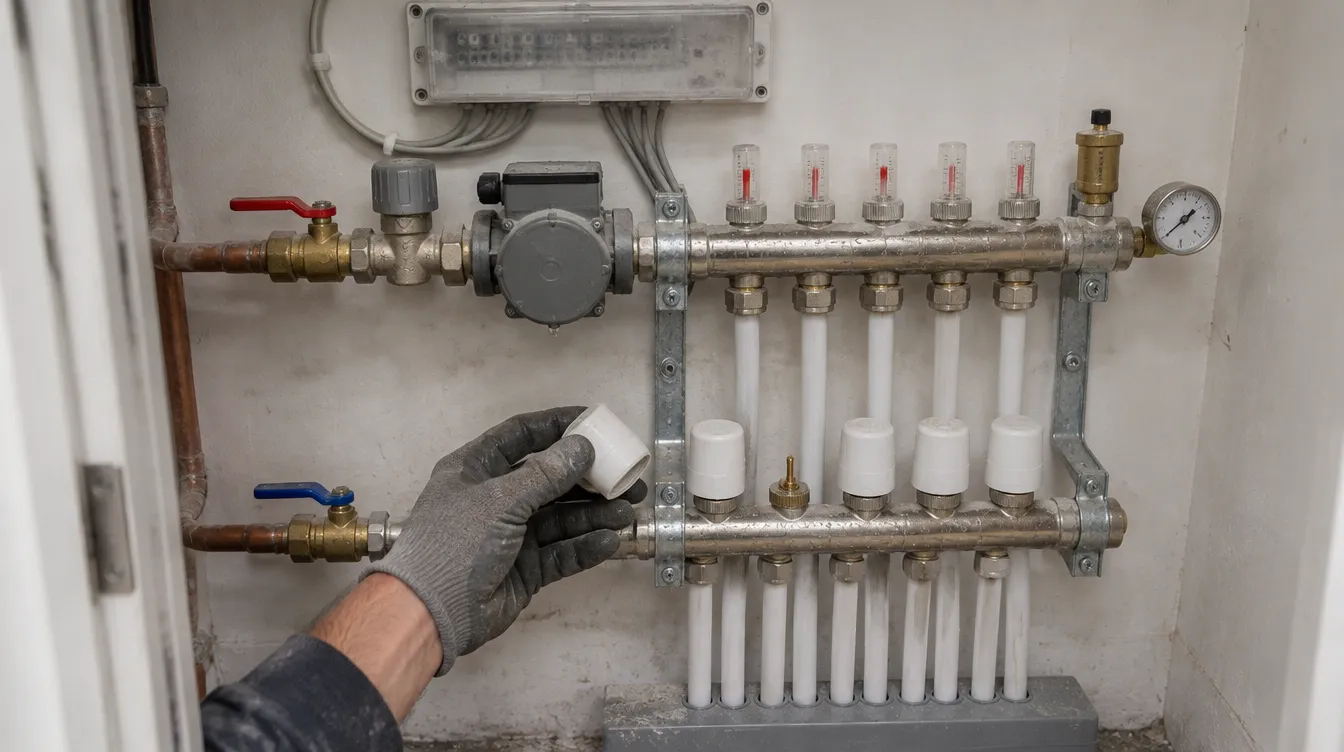
What does an underfloor heating manifold actually do?
The manifold is the distribution point between the heat source and the floor. Hot water arrives from a boiler, a heat pump or, in many London new-build flats, a heat interface unit on communal heating. The supply (flow) bar splits it into one loop per room or zone, and the return bar collects it again. NHBC Foundation guidance describes the standard layout: actuators on the return ports open and close each loop when its room thermostat calls for heat, a pump keeps water moving, and where the heat source cannot lower its own temperature, a mixing (blending) valve mixes return water in to bring the flow down to a temperature the floor can take.
That temperature matters. NHBC Foundation guidance notes that BS EN 1264-2 limits the surface of the floor to 29°C, and some floor finishes need it lower. The manifold also carries flow meters to set each loop, a pressure gauge, temperature gauges, manual air vents and drain cocks. Each part has its own way of failing, which is why the manifold is the first place an engineer looks.
Which manifold fault matches which symptom?
The symptom usually points straight at the part. This is the table our engineers work from on a first visit:
| What you notice | Most likely part | Usual fix |
|---|---|---|
| One room or zone stays cold | That loop's actuator, its valve pin, or its thermostat and wiring | Free the pin or replace the actuator; test the zone at the wiring centre |
| Every room cold, manifold pipes cool | Pump, blending valve, wiring centre power or the heat source | Free or replace the pump; reset or replace the blending valve |
| Gurgling, clicking or a loop that will not warm after a refill | Air in the manifold or a loop | Purge each loop in turn and bleed the vents |
| Pressure gauge keeps falling | Weeping joint, valve insert, vent or drain cock on the manifold | Tighten or reseal; replace washers or seals |
| Rooms warm unevenly, near rooms hot and far rooms cool | Loops never balanced, or flow meters moved | Rebalance using flow and return temperatures |
| Floor too hot or never cools down | Blending valve set too high, or an actuator stuck open | Reset the blending valve; replace the actuator |
| Flow meter shows nothing while the room calls for heat | Closed, blocked or airlocked loop, or a dirty meter | Open and purge the loop; clean or replace the meter |
If only one room is cold, our guide to underfloor heating not working in one room goes through that pattern step by step.
Why do actuators and valve pins fail?
An actuator is a small electric head that pushes down on a pin in the valve below it. When the thermostat calls for heat, the wiring centre powers the actuator and the loop opens; it usually takes a few minutes to move. Actuators wear out, and the pins under them seize when the heating sits idle over the summer, so the head moves but the valve stays shut. The picture above shows the check: take the actuator off and see whether the pin moves freely. A seized pin can often be freed on the visit; if not, the valve insert or the actuator is replaced. Neither job needs the system drained in most cases.
What goes wrong with the pump and blending valve?
The pump and blending valve serve every loop, so when they fail, the whole floor goes cold. Pumps seize after months of standing, fill with air, or are set to a speed that suits the radiators but not the floor. Blending valves stick, or someone turns them up to make a cold room warmer, which makes the warm rooms too hot without fixing the cold one. If the floor is cold everywhere and the pipes into the manifold are hot, look here first. If the pipes into the manifold are cold too, the problem is upstream: the boiler, the heat pump or the HIU. On communal heating, start with our HIU maintenance page and the guide to no hot water on communal heating.
How is air bled from an underfloor heating manifold?
Air is the classic fault after a refill, a leak repair or a new loop. NHBC Foundation guidance notes manual vents on both the supply and return manifolds for this. On a visit we follow these steps:
- Check the system is at its normal pressure and the heat source is safe to run.
- Shut every loop except one, then push water through that loop until no air comes out.
- Repeat for each loop in turn, then open them all again.
- Bleed the vents on the flow and return bars over a cloth until water runs clear.
- Top the pressure back up and confirm every flow meter shows flow.
Why does manifold pressure keep dropping?
Falling pressure means water is leaving the system, and most of the time it is at the manifold rather than in the floor. NHBC Foundation guidance says manifolds should be checked annually for leaks, and that if tightening the fittings does not cure one, the manifold may need dismantling and its washers or seals replacing. We pressure test before taking anything apart. For new loops, BS EN 1264-4 requires a test at twice the working pressure with a minimum of 6 bar, and NHBC Foundation guidance notes suppliers recommend holding it for 24 hours. On an existing floor we isolate and test loop by loop, so if a loop is losing water we know which one before any floor is touched. Our underfloor heating repair page explains how we trace a leak inside the floor.
Can a manifold be hidden in a cupboard or boxed in?
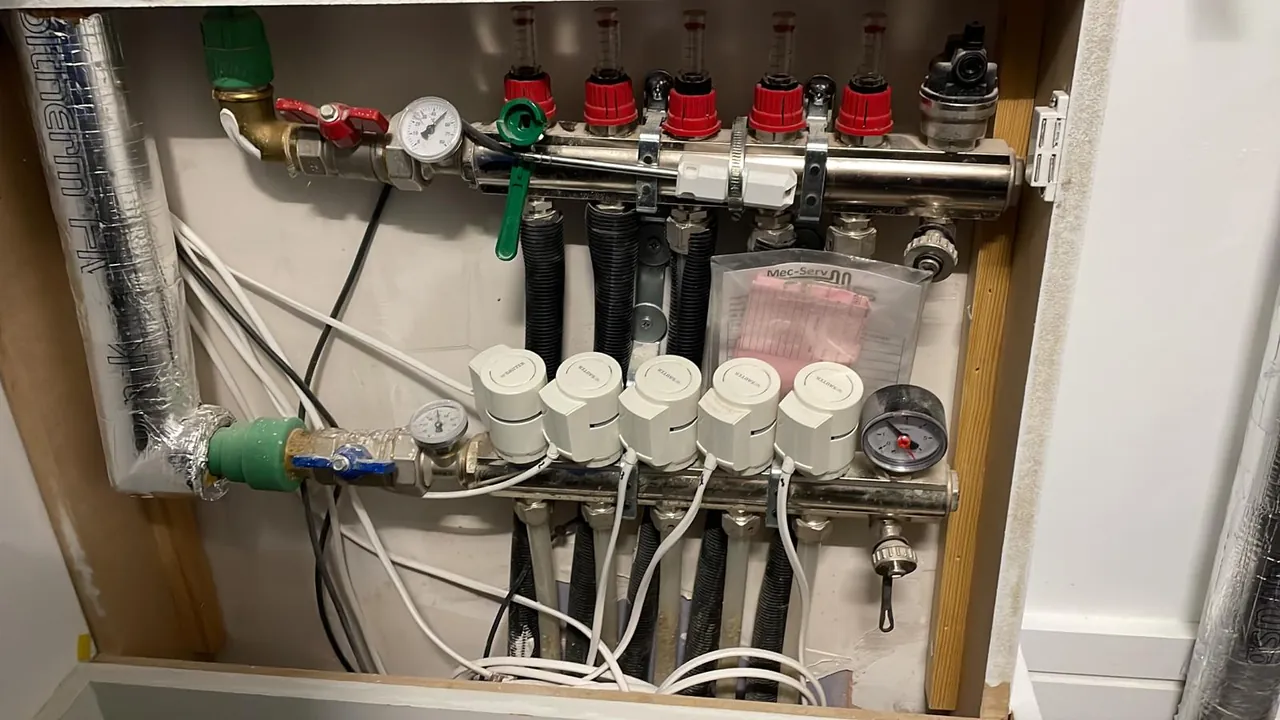
Yes, as long as it can still be reached. NHBC Foundation guidance says manifolds should be located for easy access for commissioning, repairs and maintenance. In London flats the manifold usually shares a utility cupboard with the HIU or boiler and the MVHR unit, or is boxed into a small cupboard of its own, as in the photo below. A manifold tiled or plastered in is a problem waiting to happen: every actuator, vent and joint needs access at some point.
What does an engineer check on a manifold service?
This is the checklist we work through on an annual visit, recorded loop by loop in a report with photos:
- System pressure, and the gauge compared with last year's reading
- Every joint, valve insert, vent and drain cock checked for weeping or corrosion
- Each actuator opened from its thermostat, and each valve pin checked
- Flow on every loop compared with the commissioning record, as NHBC Foundation guidance advises
- Flow and return temperatures per loop, and the loops rebalanced if needed
- Pump speed and condition, and the blending valve setting
- Air purged and vents bled
- Inhibitor level; NHBC Foundation guidance says the whole system needs normal water treatment because the manifold, pump and valves contain metal
- Thermostats, the wiring centre and any smart controls tested zone by zone
For managing agents with a block of flats on communal heating, the useful thing is doing the HIU and the underfloor heating on the same visit, flat by flat, as part of a block maintenance contract. On a heat pump, where flow temperatures are low and a badly balanced loop shows up quickly, the manifold check fits naturally into heat pump servicing. Boiler work is carried out by Gas Safe registered engineers.
We start with a site visit, free in London and, in the Home Counties, free for larger jobs, and send a digital report with photos and readings for every loop, plus a fixed quote before any work starts. Send a photo of your manifold and tell us which rooms are cold, and we can often say what to expect before we arrive. See underfloor heating repair and servicing in London.
Sources
Related services & guides
Talk to a London maintenance specialist
Whether it's one property or a portfolio, we'll put your compliance and servicing on a single planned maintenance contract. Get a no-obligation quote.