Underfloor Heating Not Working in One Room: Causes and Fixes
The rest of the flat is warm and one room stays cold. That pattern is good news: it narrows the fault down to one loop, and it is rarely in the floor itself.
Direct answer: when underfloor heating works everywhere except one room, the heat source and pump are fine and the fault is on that room's loop. The usual causes are a failed actuator, a stuck valve pin, the room thermostat or its batteries, a wiring centre fault, crossed wiring, or a closed or airlocked loop at the manifold.
Why does one cold room point to one loop?
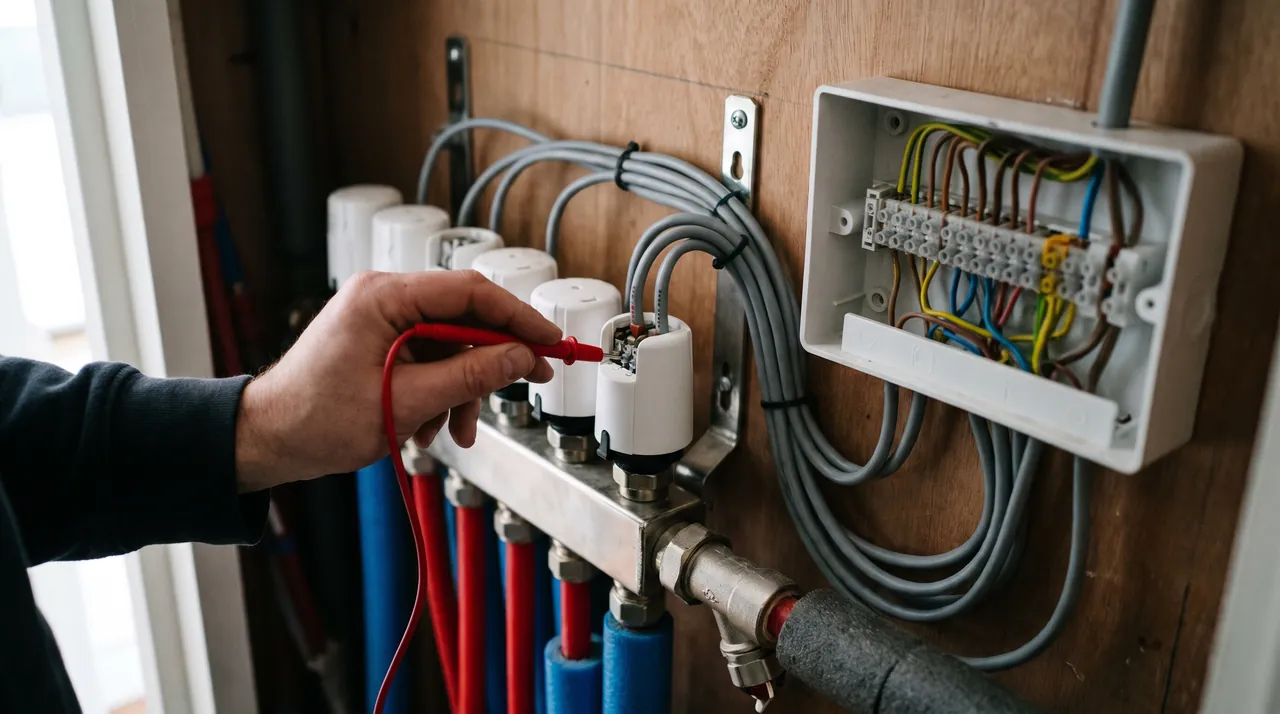
Wet underfloor heating is two chains working together. The water chain runs from the heat source (a boiler, a heat pump, or a heat interface unit on communal heating) through a pump and blending valve to the manifold, which splits the water into one or more loops per room. The controls chain runs from each room thermostat to the wiring centre, which opens the actuators on that room's loops and switches the pump.
If the other rooms are warm, everything shared is working: the heat source, the pump, the blending valve and the power to the wiring centre. What is left is the part that belongs to the cold room only. That is why a cold room is usually a quick fix, and why the floor rarely needs to be touched. Our underfloor heating repair page shows the four fault patterns side by side, including the whole floor being cold and warm-in-patches cold spots.
What are the usual causes of one cold zone?
In rough order of how often they turn up on a visit:
- A failed actuator. The small electric head on the manifold that opens the loop. They wear out, and when one fails the loop stays shut.
- A stuck valve pin. The actuator works, but the pin in the valve under it has seized, often after the summer. The loop stays shut anyway.
- The room thermostat. Flat batteries, a lost wireless link, the wrong mode, or a setting someone changed.
- The wiring centre. A relay for that zone not switching, or a loose terminal.
- Crossed wiring. The thermostat in one room is wired to the actuator of another, so turning up the cold room heats the room next door. Common after a refit.
- A closed, blocked or airlocked loop. A balancing valve shut by mistake, air trapped in the loop, or sludge in an older system. The flow meter for that loop shows nothing.
What can I check myself before calling anyone?
A few safe checks narrow it down. Leave anything inside the wiring centre, and anything needing tools on the manifold, to an engineer.
| Check | What you see | What it points to |
|---|---|---|
| Room thermostat | Blank screen, low battery symbol or no heat call | Batteries, settings or lost wireless link |
| Wiring centre lights | No light for that zone when the room calls for heat | Thermostat or its wiring, not the manifold |
| Actuator indicator | Zone light is on but the actuator does not open after a few minutes | Failed actuator or stuck valve pin |
| Flow meter for that loop | Nothing showing while the actuator is open | Closed, blocked or airlocked loop |
| Another room warms instead | Turning up the cold room heats a different room | Thermostat wired to the wrong actuator |
| System pressure gauge | Pressure low or falling | A leak or air in the system, usually at the manifold |
Give it time before deciding something is wrong. A loop in a screed floor can take a few hours to warm a room from cold, so a room that was switched off overnight is not necessarily faulty at breakfast.
How does an engineer find the fault?
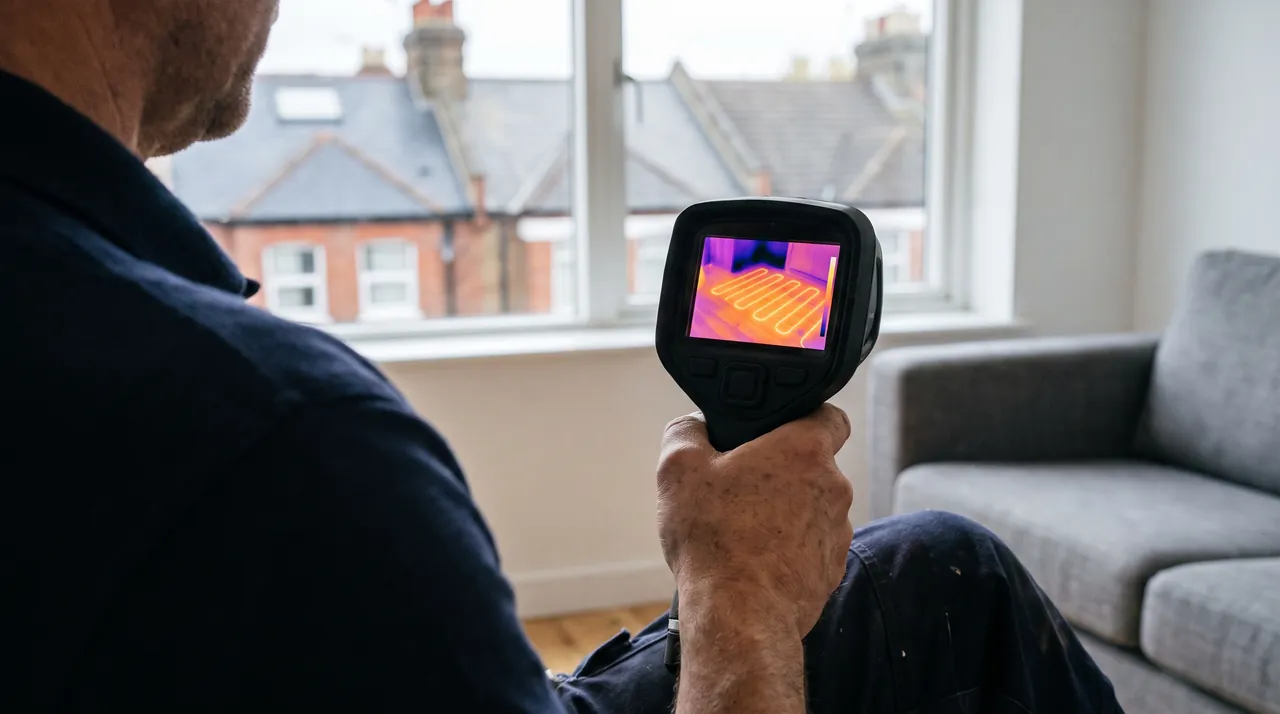
On a visit we work along both chains for that room only. The thermostat is tested and its call for heat followed to the wiring centre. The supply at the actuator is measured, and the actuator is taken off to see whether the valve pin moves. Flow and return temperatures for the loop are compared with the warm loops beside it. A thermal camera shows clearly whether water is moving through the floor of that room.
If the pressure has been dropping, we pressure test the system before anything is taken apart, then test loop by loop at the manifold to find which loop is losing water. Most leaks are at the manifold or its connections rather than in the floor.
Is it different in a flat on communal heating?
The one-room logic is the same. Many London new-build flats have no boiler: heat arrives from the building's heat network through a heat interface unit, then through a mixing unit into the manifold. If one room is cold and the others are warm, the HIU is very unlikely to be the cause. If every room is cold, or hot water is also weak, start with the HIU; our guide to no hot water in a flat on communal heating covers that side.
For managing agents, the useful point is that the HIU, the mixing unit and the manifold are often looked after by different contractors. We service heat interface units and underfloor heating, so one engineer can check the whole chain on the same visit and record it per flat. The winter readiness checklist for residential blocks includes underfloor heating checks alongside the HIU programme.
What about underfloor heating on a heat pump?
Heat pumps run at low flow temperatures, which suits underfloor heating well, but it also means there is less spare heat to hide a problem. A loop that is slightly out of balance on a boiler may simply leave a room cold on a heat pump. If one room is cold, check the loop and controls first. If several rooms are slow to warm, the flow temperature, the heat pump settings or its filters may need looking at during heat pump servicing.
Could the controls themselves be the problem?
Sometimes the room is not faulty at all, it is simply not controlled on its own. Approved Document L expects new homes to have thermostatic control in each heated room, with zone control allowed where two neighbouring rooms have similar heating needs. Older or altered flats sometimes run several rooms from one thermostat, so the room furthest from it is always cooler. Splitting it into zones, or moving to smart underfloor heating controls that manage each zone separately, can solve it; see smart home installation for controls that work with underfloor zones.
Do not try to fix a cold room by turning the blending valve up. NHBC Foundation guidance notes that BS EN 1264 limits the surface of an occupied floor to 29°C, and some timber and vinyl finishes need it lower. A hotter floor elsewhere will not warm a loop that is shut.
We start with a site visit, free in London and, in the Home Counties, free for larger jobs, and send a digital report with photos and readings for every loop, plus a fixed quote before any work starts. Send a photo of the manifold and say which rooms are cold, and we can often tell you what to expect before we arrive.
Sources
Related services & guides
Talk to a London maintenance specialist
Whether it's one property or a portfolio, we'll put your compliance and servicing on a single planned maintenance contract. Get a no-obligation quote.