What Is a BMS? A Plain-English Guide for Building Managers
The building management system is the brain behind the plant room. Here is what it is, what it controls, when the rules expect one, and what to look for when it stops doing its job.
A building management system (BMS) is a computer-based control system that runs a building's heating, cooling, ventilation and related plant from one place. Sensors measure conditions, controllers decide what to do, and actuators, valves and motor starters carry it out. The BMS also raises alarms and logs energy data, so faults are caught and running costs can be cut.
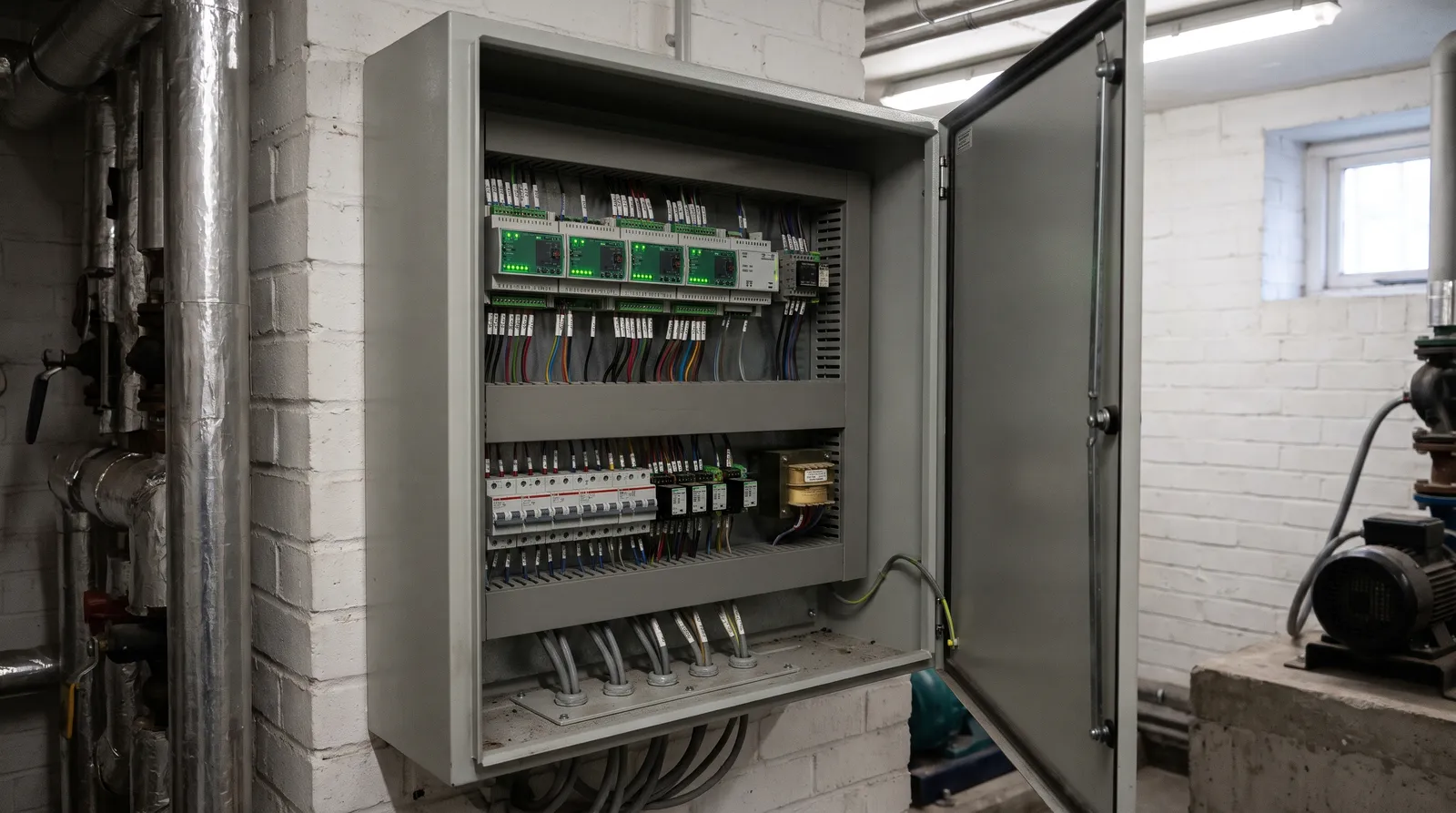
What does a BMS actually control?
A BMS controls the building services that use the most energy and cause the most complaints: heating, hot water, cooling and ventilation, plus often lighting, metering and plant alarms. In a London office that usually means boilers or heat pumps, chillers, air handling units and hundreds of fan coil units. In a residential block or build-to-rent scheme it is more often the communal plant room: the boilers or heat pumps feeding the heat network, the pumps, pressurisation units and plate heat exchangers, car park and corridor ventilation, and landlord lighting.
The flats themselves are usually served by a heat interface unit each, and some BMS installs monitor those too. If you are new to communal heating, our guide on how often an HIU should be serviced explains how the two fit together.
How does a building management system work?
Every BMS, from a single plant room to a whole estate, works in the same four layers: sensors read, controllers decide, actuators act, and a front end lets people see and change what is happening. Controllers are often called outstations, and they talk to each other and to the front end over a network using an open protocol such as BACnet or Modbus, or a maker's own protocol.
- Sense. A pipe sensor reads 58°C on the heating flow when the setpoint is 70°C.
- Decide. The controller's programme compares the reading with the setpoint and the time schedule.
- Act. It opens the mixing valve actuator further, or enables a second boiler or pump.
- Report. If the flow stays low, it raises an alarm on the front end and logs the event.
| Layer | What it is | Typical examples | What usually goes wrong |
|---|---|---|---|
| Sensors (inputs) | Devices that measure | Room, pipe, duct and outside air sensors; pressure and flow switches; run and fault signals; meters | Drift out of calibration, failed or disconnected, mounted in the wrong place |
| Controllers (outstations) | The programmable brains, usually in a panel | DIN-rail controllers and input/output modules | Lost programme, flat backup battery, obsolete hardware with no spares |
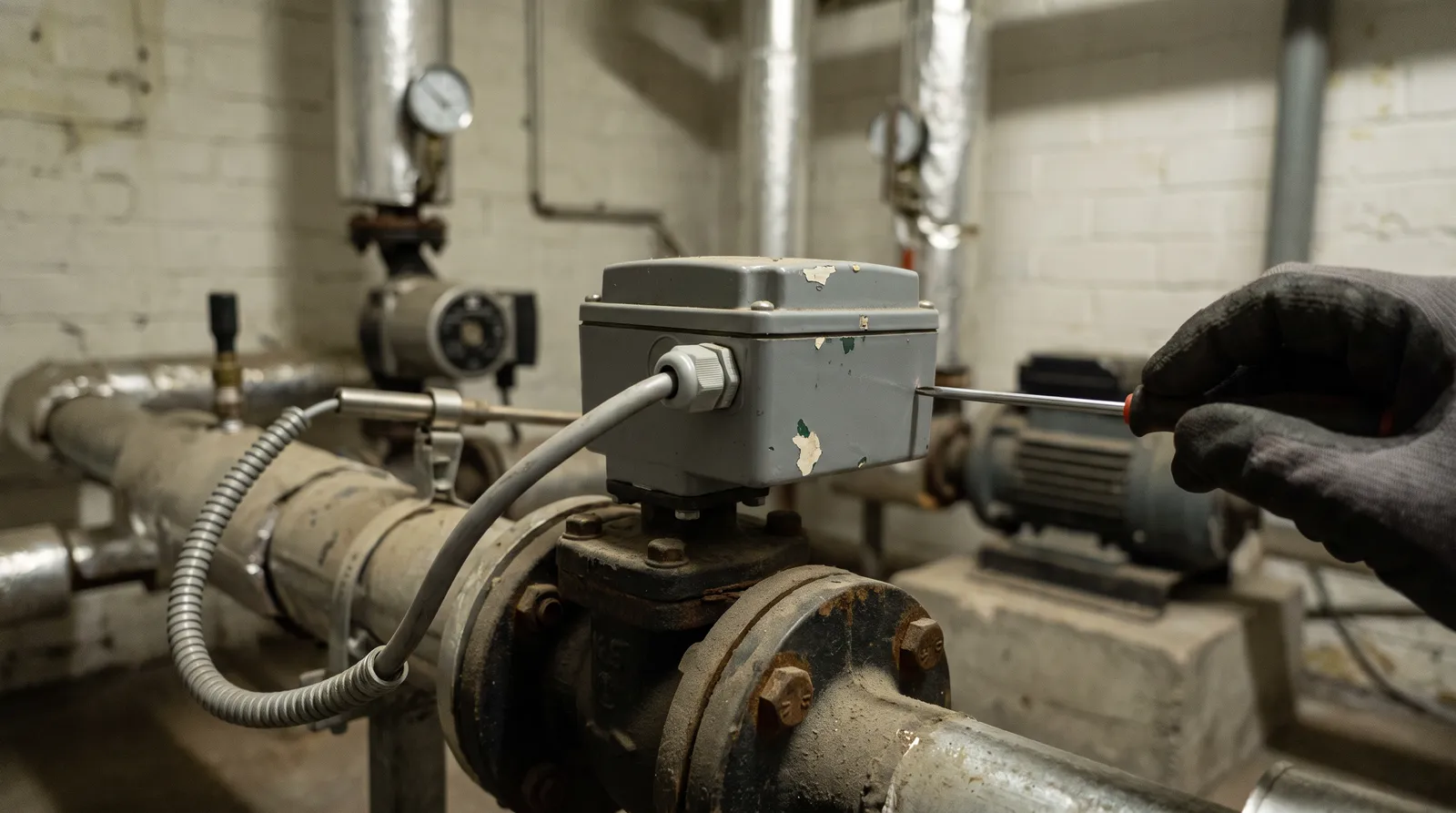
| Outputs | Devices that act | Valve and damper actuators, pump and fan starters, inverters, relays | Seized valves, failed actuators, plant left in "hand" on the panel |
| Front end (supervisor) | The screen people use | Graphics on a PC or web browser, alarms, trend logs, schedules | Old PC, lost passwords, alarms nobody receives, no remote access |
Is a BMS a legal requirement in England?
For buildings other than dwellings, the government's Approved Document L Volume 2 (2021 edition incorporating 2023 amendments) says a new building should have a building automation and control system where its space heating or air-conditioning system has an effective rated output greater than 180kW (paragraph 6.66). The same applies to heating or cooling combined with ventilation.
In an existing building over 180kW, a system being installed or replaced should meet the same standard (paragraph 6.67). Paragraph 6.72 lists what that system should do: comply with BS EN ISO 16484, continuously monitor, log and analyse energy use, benchmark the building and spot falling efficiency in heating, ventilation and air conditioning, tell the person responsible about improvements, and work with equipment from different manufacturers. Where heat comes from a district or community heat network, the 180kW is based on the equipment inside the building (paragraph 6.70). Below the threshold, centralised controls are still recommended (paragraph 6.68).
For residential blocks on a communal heat network, the BMS is also where much of the operating data lives. With Ofgem now regulating heat networks, good records matter more than ever: see our guide to the heat network regulations for managing agents.
BMS, BEMS, BACS or SCADA: what is the difference?
BMS, BEMS and BACS are names for the same kind of system; SCADA is the industrial cousin. "BEMS" puts the emphasis on energy monitoring, "BACS" is the term the Building Regulations and BS EN ISO 16484 use, and "BAS" is common in American material. SCADA is used for process plant and utilities spread over large sites. A BMS is also not BIM: BIM is the digital model used to design and record a building, while the BMS runs it day to day, although BIM data can feed a new BMS.
Which BMS brands are common in London buildings?
In London you will most often find Trend, Siemens, Honeywell, Johnson Controls, Schneider Electric, Tridium Niagara, Delta Controls, Distech and Titan Products, with older Satchwell and Cylon systems still running in many buildings. The brand matters less than whether the system is supported, documented and backed up. We work on all of them, including Trend, Tridium Niagara and Delta Controls, and on orphaned systems whose original installer has gone.
What does an engineer check on a BMS site visit?
A useful BMS visit checks the whole loop, from the front end down to the valve, not just whether the screen is on. This is the checklist our engineers work through on a survey of an existing system:
- Front end: can we log in, who holds the passwords, is there a current backup of every controller programme?
- Alarms: are they going to someone, and how many are standing or ignored?
- Panels: any plant left in hand or off on the hand-off-auto switches, lamps not working, signs of heat or water damage?
- Controllers: status lights, comms errors, backup batteries, firmware and spares availability
- Sensors: readings compared with a calibrated thermometer or gauge, especially outside air and flow sensors
- Valves and actuators: stroke them from the BMS and watch them move fully open and closed
- Time schedules and setpoints: do they match how the building is actually used, including holidays?
- Trend logs: heating and cooling fighting each other, plant running overnight, short cycling
Across London and the Home Counties, that visit is free, and you receive a digital report with photos of what we found. If something has already failed, our BMS fault finding service traces it; if the system is simply old, see BMS upgrades; and to keep it healthy, planned BMS maintenance covers it year round. Where the system works but wastes energy, BMS optimisation is the place to start.
Who looks after a BMS in a block or office?
Usually the building owner, managing agent or facilities manager holds a maintenance contract with a controls engineer, and the BMS sits alongside the plant room contract. Problems start when nobody owns it: the installer has gone, the passwords left with them, and every fault becomes a call-out. Bringing the BMS, plant room and HVAC under one planned maintenance arrangement means one team sees both the controls and the kit they control.
To talk about a BMS in your building, see our building management systems service and book the free site visit.
Sources
Related services & guides
Talk to a London maintenance specialist
Whether it's one property or a portfolio, we'll put your compliance and servicing on a single planned maintenance contract. Get a no-obligation quote.