Pressure testing · Loop by loop · Thermal imaging · London
Underfloor Heating Leak Detection in London
Pressure dropping, a damp patch, or a stain on the ceiling below? We find exactly where your underfloor heating is leaking before anything is taken apart, so only the smallest area is opened, if any.
- Leak found before the floor is touched
- Report with photos and readings
- HIU and manifold checked together
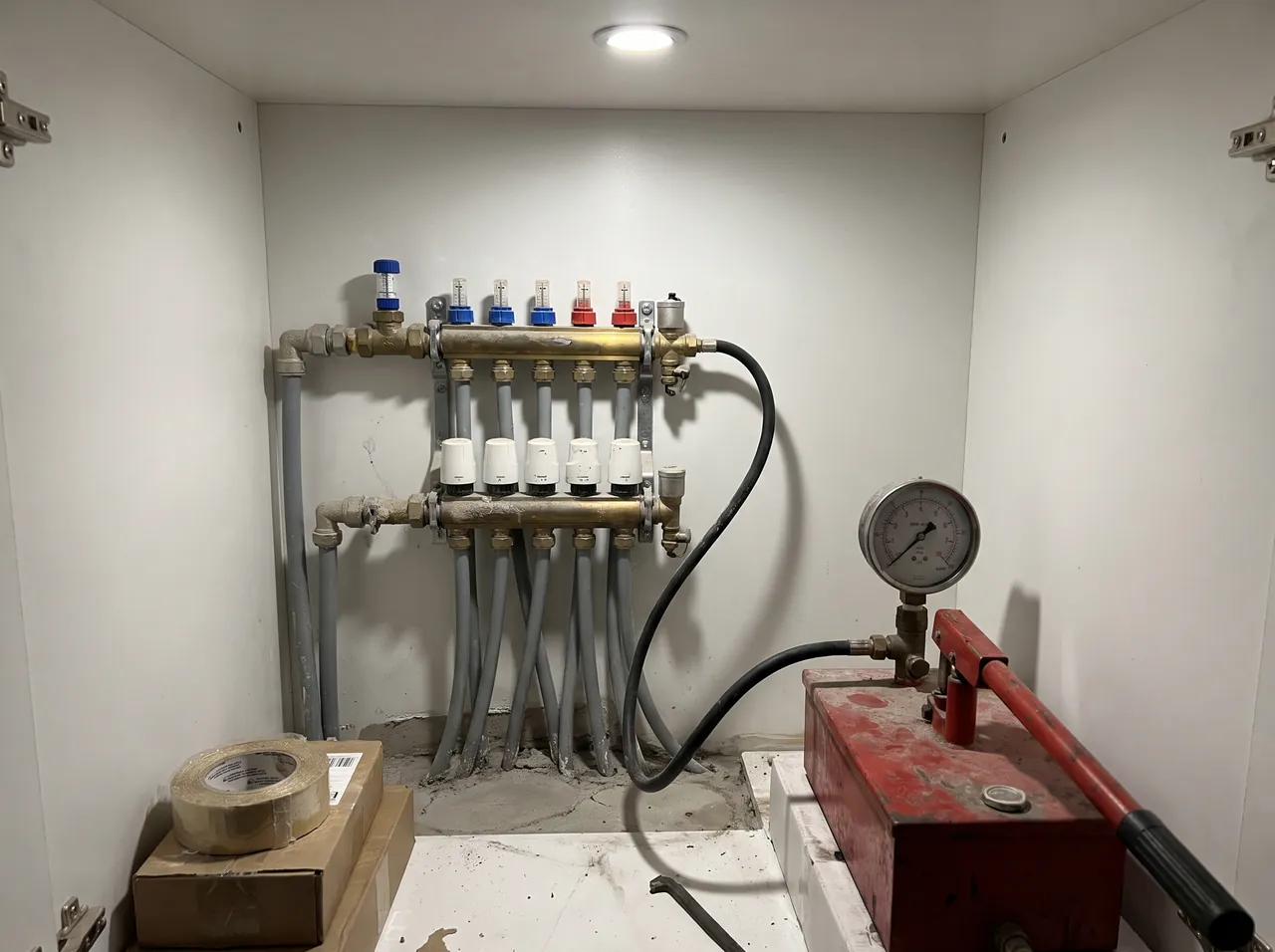
How do you find an underfloor heating leak without lifting the floor?
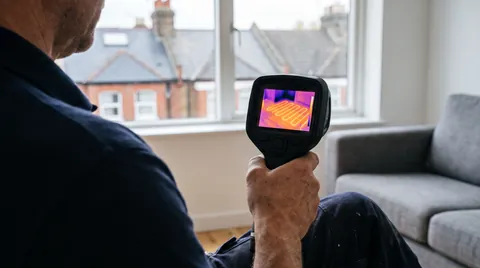
We pressure test the system, check the manifold and the heat source, then test each loop on its own at the manifold to find which one is losing pressure. A thermal camera and a moisture meter then show where on that loop the water is escaping, so only the floor over that spot is opened.
Most pressure loss is not in the floor at all. It is at the manifold, or at the boiler or heat interface unit that feeds it. That is why we check the whole chain first. For other faults, see our underfloor heating repair and servicing page.
Signs Your Underfloor Heating Is Leaking
Any one of these is worth a check. Two or more together usually means water is escaping somewhere in the system.
Pressure keeps dropping
The gauge on the manifold, boiler or HIU falls below 1 bar again days after it was topped up.
Damp near the manifold
Water marks, rust or white crusting on the manifold, its valves or the floor of the cupboard.
A warm, damp patch
A spot on the floor that feels warmer than the rest, or grout that stays darker after cleaning.
A stain on the ceiling below
In a flat, the first sign is often the neighbour underneath reporting a mark on their ceiling.
Lifting or cupping floor
Timber or laminate that swells, cups or creaks, or tiles that sound hollow when tapped.
Heating keeps losing pressure and stops
The boiler or HIU locks out on low pressure, so the floor and the radiators go cold.
Where Underfloor Heating Leaks Actually Happen
Pipe laid in screed rarely fails on its own. Most problems are where the pipe joins something.
At the manifold
- Pipe connections (eurocones) weeping
- Isolating valves and flow meters
- Air vents and drain cocks
- Corroded or overtightened fittings
Reached in the cupboard, so no floor is touched.
At the heat source
- Pressure relief valve letting by
- Expansion vessel lost its charge
- A weep inside the HIU or boiler
- Filling loop left part open
The pressure drops, but the floor is dry. We check these first.
In the floor
- A screw, nail or drill through a pipe
- Damage while fitting a kitchen or flooring
- A joint left under the screed when laid
- Old pipe without an oxygen barrier
Found and opened at one spot only.
How We Find the Leak, Step by Step
Each step rules out part of the system, so by the time anything is opened we know exactly where the water is going.
- STEP 1
Check the pressure parts
Relief valve, expansion vessel, filling loop and the HIU or boiler. A dry floor with falling pressure often ends here.
- STEP 2
Inspect the manifold
Every connection, valve, flow meter and air vent checked for weeps, marks and corrosion.
- STEP 3
Pressure test
The system is filled to test pressure with a hand pump and watched on a gauge to confirm a leak and measure how fast it drops.
- STEP 4
Loop by loop
Each loop is isolated at the manifold and tested on its own, which tells us the room and the circuit that is leaking.
- STEP 5
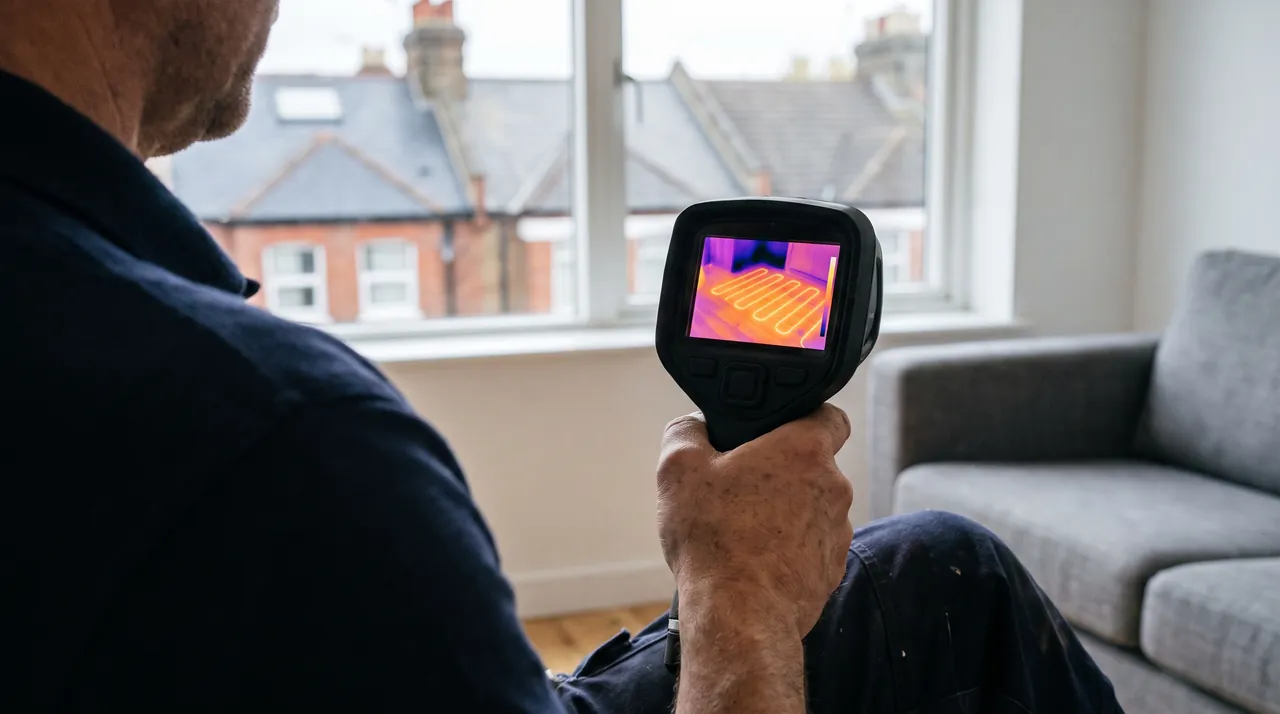
Thermal camera and moisture meter
Warm water run through that loop shows its path and the spreading patch where it escapes. A moisture meter confirms it is water.
- STEP 6
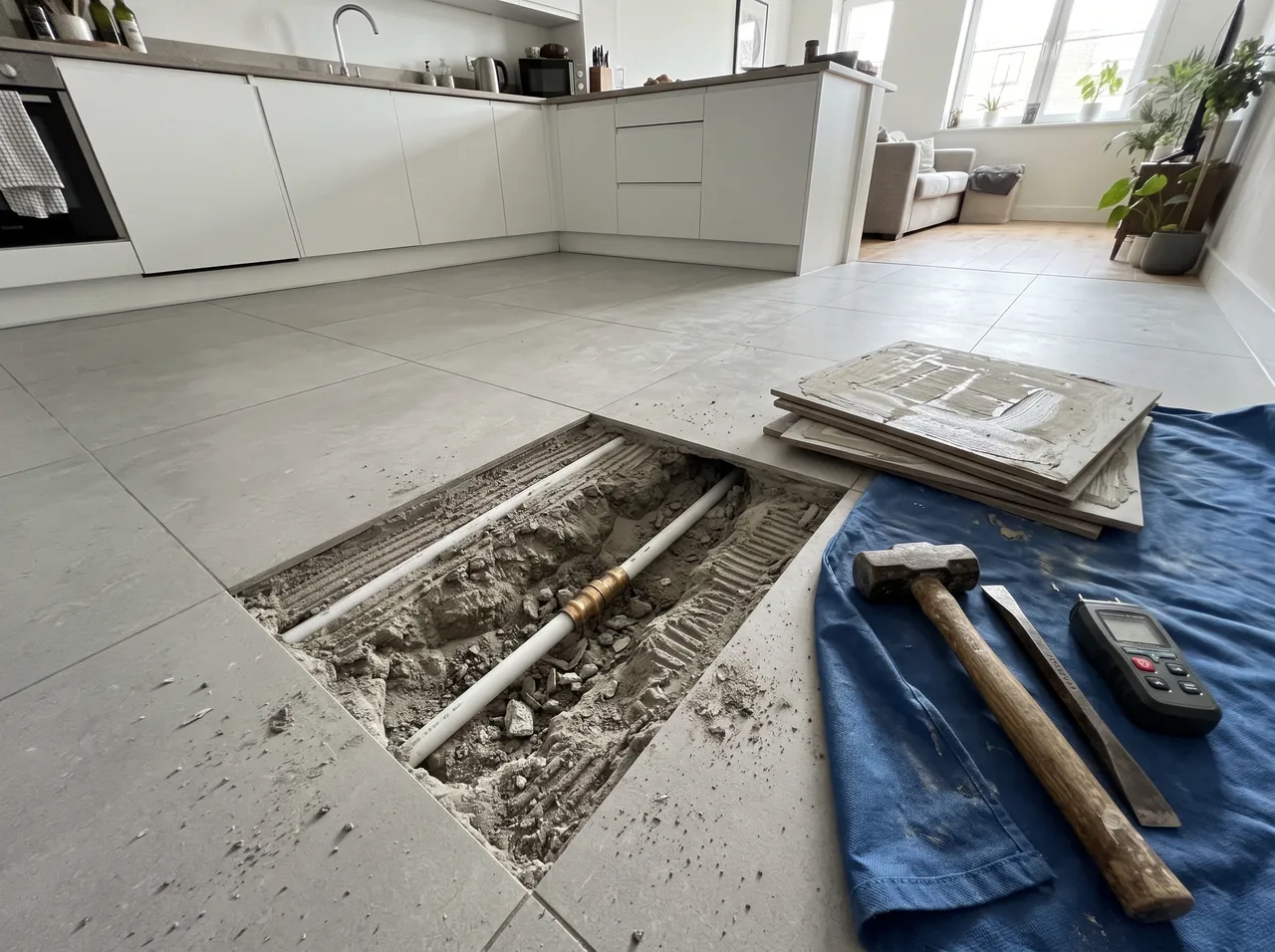
Open one spot, repair, re-test
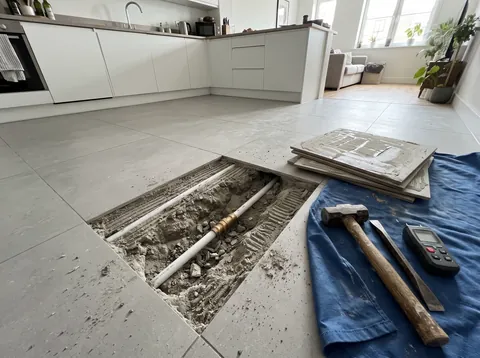
Only the tiles or boards over that spot are lifted. The pipe is joined with a repair coupling and pressure tested before the floor goes back.
If the leak turns out to be at the manifold or the heat source, we stop at that step and nothing in the floor is disturbed.
Once the Leak Is Found: How It Is Fixed
You get a fixed quote for the repair before any work starts. Most leaks never need the floor opened.
Weeping pipe connection at the manifold
Remake or replace the fitting, then pressure test
Floor opened: No
Faulty manifold valve, flow meter or air vent
Replace the part
Floor opened: No
Pressure relief valve or expansion vessel
Replace the valve, or recharge or replace the vessel
Floor opened: No
Weep inside the HIU or boiler
Repair the unit (gas work by Gas Safe registered engineers)
Floor opened: No
Pipe damaged in the floor
Lift the tiles or boards over that spot, open the screed, fit a repair coupling, pressure test, then reinstate
Floor opened: One small area, often a couple of tiles
Loop damaged in several places
We explain the options: repair, isolate that loop, or re-pipe that one room
Floor opened: Quoted and agreed before any work
| Where the leak is | Usual fix | Floor opened? |
|---|---|---|
| Weeping pipe connection at the manifold | Remake or replace the fitting, then pressure test | No |
| Faulty manifold valve, flow meter or air vent | Replace the part | No |
| Pressure relief valve or expansion vessel | Replace the valve, or recharge or replace the vessel | No |
| Weep inside the HIU or boiler | Repair the unit (gas work by Gas Safe registered engineers) | No |
| Pipe damaged in the floor | Lift the tiles or boards over that spot, open the screed, fit a repair coupling, pressure test, then reinstate | One small area, often a couple of tiles |
| Loop damaged in several places | We explain the options: repair, isolate that loop, or re-pipe that one room | Quoted and agreed before any work |
Think You Have a Leak? What to Do Now
- 1Take a photo of the pressure gauge and note when you last topped it up
- 2If water is coming through a ceiling, turn the heating off and call us on the 24/7 line
- 3Tell your managing agent or landlord if you live in a flat, especially if it affects the flat below
- 4Check your home insurance: many policies include trace and access cover for finding a hidden leak
For Managing Agents and Blocks
- One engineer checks the HIU, the manifold and the floor together, so the leak is not passed between trades
- A written report with photos and pressure readings, ready to send to the leaseholder or the insurer
- Leaks into the flat below treated as urgent, with a 24/7 line for nights and weekends
- Underfloor heating can sit inside a block maintenance contract with the HIUs
See our block maintenance contracts and heat network maintenance.
A photographed PDF report after every leak detection visit
No handwritten job sheets and no chasing. Our engineers complete each job electronically on site in Maintivo, our job management system, so the report is built as the work happens: photos, readings, work done and recommendations.
You receive it as a digital PDF by email the same day, with certificates attached where they apply, ready to forward to a landlord, a freeholder, the directors or an insurer.
- Before and after photosEvery unit and fault photographed on site
- Readings and checksTemperatures, pressures and test results recorded
- Work done and next stepsWhat was fixed, what needs quoting, when we return
- Sent the same dayDigital PDF report by email, ready to forward
Example layout. Completed on site in Maintivo.
Who Does the Work
Gas work on boilers is carried out by Gas Safe registered engineers.
What customers say on Google
“I've had the pleasure of working with Petru and his team on a number of maintenance jobs, and they've always been fantastic. They're professional, reliable, and complete every job to a really high standard. Petru is incredibly knowledgeable and it's clear he takes pride in his work.”
Deborah L.
Google review
“Excellent service. Price assessment: reasonable price.”
Attila B.
Google review
“The team is knowledgeable, efficient, and attentive to detail. A great choice for anyone looking for reliable maintenance services. Highly recommended!”
Ben
Google review
Book Underfloor Heating Leak Detection
Tell us what you are seeing: the pressure reading, any damp, and whether the flat below is affected. If water is coming through a ceiling, call the 24/7 line now.