How Is an Underfloor Heating Leak Found Without Lifting the Floor?
Falling pressure, a damp patch or a stain on the ceiling below does not mean the floor has to come up. Here is how an engineer narrows a leak down, one step at a time.
Direct answer: an underfloor heating leak is found by elimination. The engineer checks the boiler or HIU and the manifold first, then isolates each loop at the manifold and pressure tests it on its own. Once the leaking loop is known, a thermal camera and a moisture meter show the exact spot, so only that spot is opened.
That is the method behind our underfloor heating leak detection service in London. This guide explains each step, what it rules out, and what you can check yourself before an engineer arrives.
Can underfloor heating leak?
Yes, but the pipe in the floor is rarely where it happens. NHBC Foundation guidance on underfloor heating says the loops should have no joints, with every connection for maintenance located above the floor finish at the manifold, which makes the installation relatively robust against leaks. The same guidance warns that the loops are vulnerable to puncture by later building work that involves screwing or drilling into the floor. In practice, that is the pattern we see: a new kitchen island, a fixed WC or a fitted floor, and a pipe pierced by a fixing.
Everything else that can lose water sits outside the floor: the manifold joints, valves, flow meters and air vents, and the pressure parts on the boiler or heat interface unit. Those are checked first because they can be reached without disturbing anything.
What are the signs of an underfloor heating leak?
- The pressure gauge keeps falling below about 1 bar and needs topping up again within days
- Damp, rust or white crusting on the manifold or the cupboard floor under it
- A patch of floor that feels warmer than the rest, or grout that stays dark
- Timber or laminate that cups, swells or creaks; tiles that sound hollow
- A stain on the ceiling of the flat below
- The boiler or HIU locking out on low pressure, so the heating stops
Why is the heat source checked before the floor?
Because falling pressure with a dry floor usually ends there. A pressure relief valve that lets by, an expansion vessel that has lost its air charge, a weep inside the boiler or HIU, or a filling loop left slightly open will all make the gauge drop. A relief valve often discharges through a pipe to the outside, so the water disappears without a mark. Checking these parts takes minutes and saves a day of searching the floor. Gas work on boilers is carried out by Gas Safe registered engineers.
How does a pressure test show which loop is leaking?
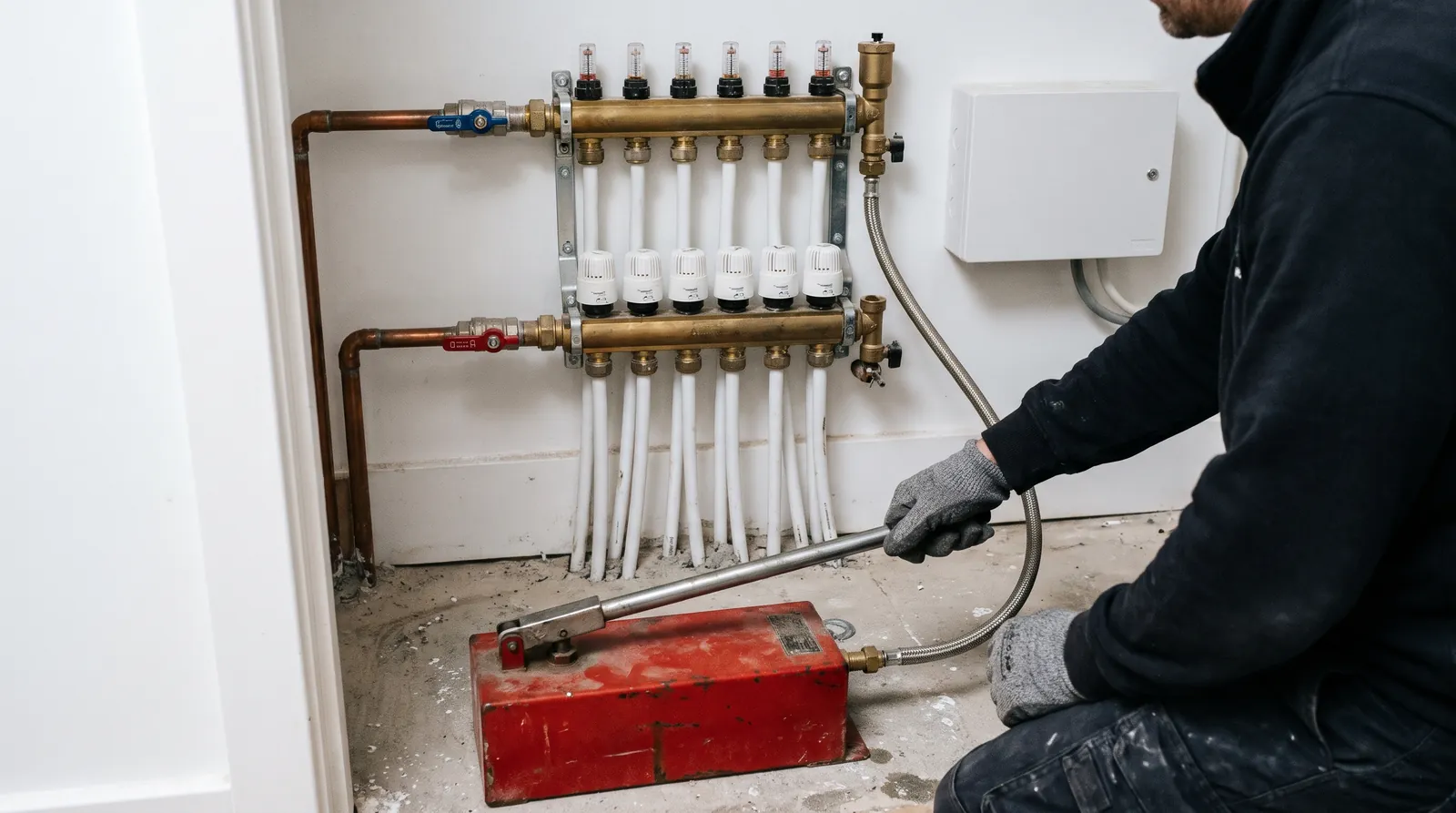
A pressure test confirms there is a leak, measures how fast it is, and then narrows it to one loop. NHBC Foundation guidance says new underfloor heating loops are tested at twice the working pressure to meet BS EN 1264-4, which requires a minimum of 6 bar, with suppliers recommending up to twice that, held for 24 hours. On an existing system the engineer picks a test pressure that the manifold, the heat source and their valves can safely take. The steps on site are:
- Isolate the manifold from the boiler or HIU, so the test only sees the underfloor heating.
- Connect a hand test pump to the manifold fill point and raise the pressure.
- Watch the gauge. If it holds, the loops are sound and the leak is elsewhere.
- If it falls, close every loop and open them one at a time, testing each on its own.
- The loop that loses pressure is the leaking one, which tells you the room and the circuit.
How do thermal imaging and a moisture meter find the exact spot?
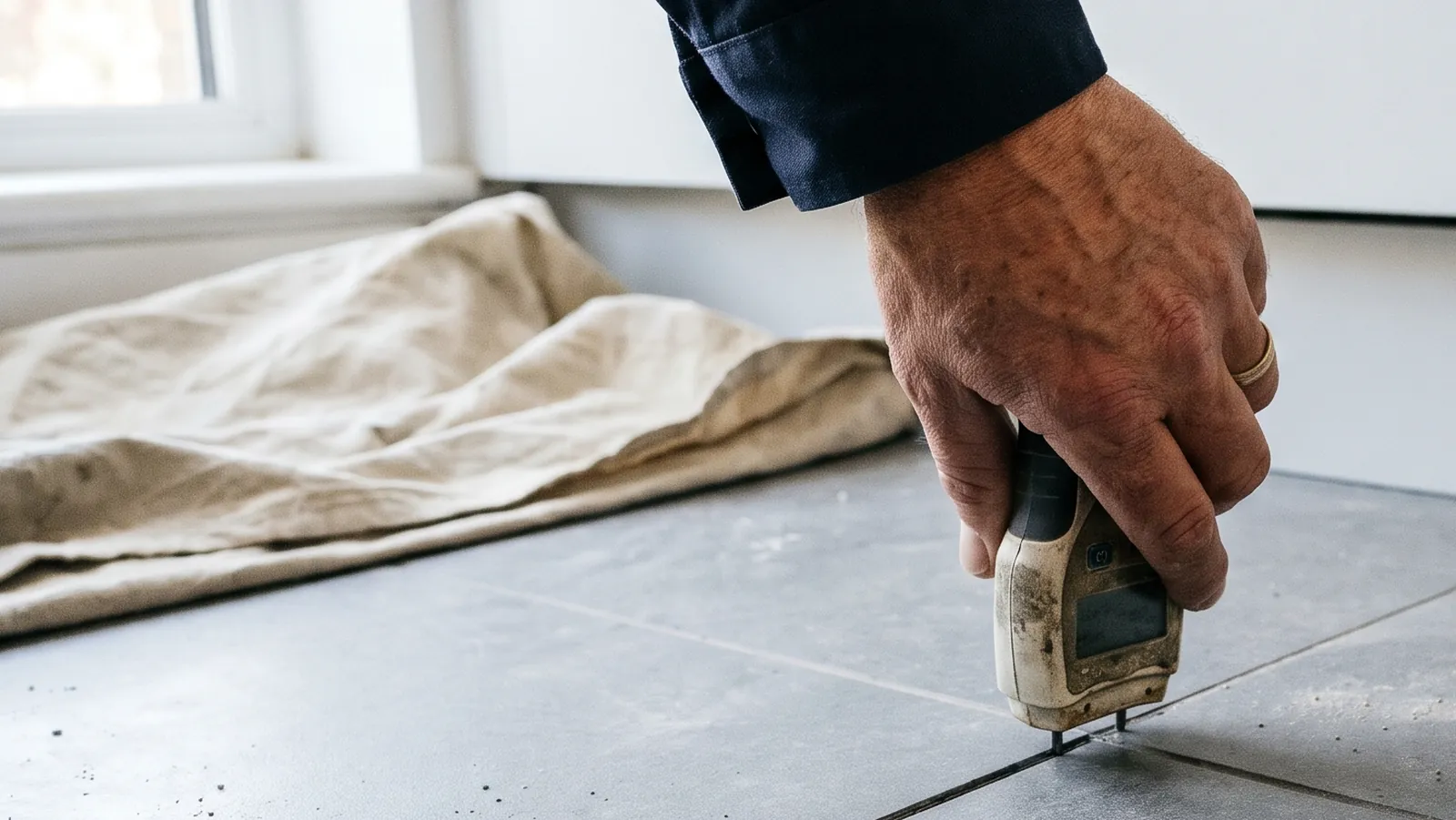
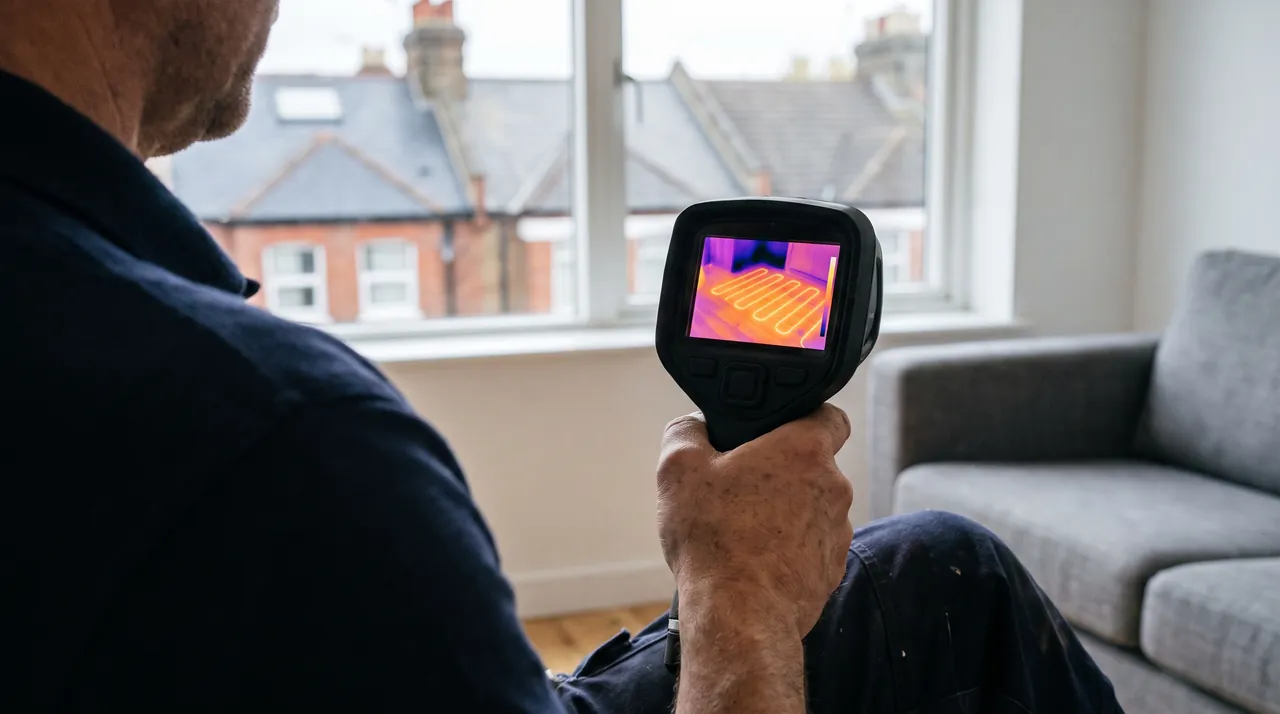
Warm water is run through the leaking loop only, and a thermal camera is used over that room. NHBC Foundation guidance notes that a thermal imaging camera shows the routes of the pipework under the floor, and it recommends a thermographic survey after commissioning to keep a record of where the pipes run. A leak shows as heat spreading where no pipe should be, often next to a fixing point. A moisture meter on the grout or the boards then confirms the patch is wet and shows how far it has spread.
Some leak specialists also use tracer gas or acoustic listening equipment, mostly for mains water pipes and for leaks that thermal imaging cannot see. On wet underfloor heating, the loop isolated at the manifold and a warm-water thermal check usually narrows the leak to a small area first.
Where should you look first? A quick decision table
Use what you can see to judge where the search will start, and how likely it is that any floor is opened:
| What you notice | Where the engineer looks first | Floor likely to be opened? |
|---|---|---|
| Pressure falls, floor and manifold dry | Relief valve, expansion vessel, boiler or HIU | No |
| Damp or crusting in the manifold cupboard | Manifold joints, valves, flow meters, air vents | No |
| Warm damp patch in one room | That room's loop, tested at the manifold, then thermal camera | One small spot |
| Stain on the ceiling below | Manifold, then loops over the stain; also bathroom and kitchen pipework | Only if a floor loop fails its test |
| Leak began after building or fitting work | Loops under the new fixings | One small spot |
What happens in a flat when water reaches the flat below?
Turn the heating off, stop topping up the pressure, and call for help: our 24/7 emergency line covers nights and weekends. In a block, also tell the managing agent or landlord, because they may need access to the flat below and to any communal pipework. Many home insurance policies include trace and access cover for finding a hidden leak, so check yours and keep the engineer's report with photos and pressure readings for the claim. For managing agents, underfloor heating can sit inside a block maintenance contract alongside the HIUs, so one engineer checks the HIU, the manifold and the floor together.
How is the leak repaired once it is found?
At the manifold, NHBC Foundation guidance says leaks that tightening the fittings does not cure may need the manifold dismantled and its washers or seals replaced; our guide to underfloor heating manifold problems covers those faults. In the floor, the tiles or boards over the spot are lifted, a small pocket of screed is opened, the pipe is joined with a repair coupling, and the loop is pressure tested before the floor is put back. If a room is cold rather than wet, see underfloor heating not working in one room. For servicing and other faults, including heat pump systems, see our underfloor heating repair page and heat pump servicing.
How can you lower the chance of a leak?
- Keep the installer's loop layout drawing, or a thermal record of the floor, with the property file
- Check the layout before anyone screws, nails or drills into a floor with underfloor heating
- Have the manifold checked once a year; NHBC Foundation guidance says manifolds should be checked annually for signs of leaks
- Keep the manifold reachable, never tiled or plastered in
- Note the pressure reading each month, so a slow drop is spotted early
We start with a site visit, free in London and, in the Home Counties, free for larger jobs. You get a digital report with photos and pressure readings, and a fixed quote for any repair before work starts. See underfloor heating leak detection in London, or call the 24/7 line if water is coming through a ceiling.
Sources
Related services & guides
Talk to a London maintenance specialist
Whether it's one property or a portfolio, we'll put your compliance and servicing on a single planned maintenance contract. Get a no-obligation quote.