What Is a Heat Interface Unit (HIU)? How It Works and Who Looks After It
If your flat has no boiler, just a white box in a cupboard with pipes coming up through the floor, that box is a heat interface unit. Here is what it does, what is inside it, and whose job it is to keep it working.
Direct answer: a heat interface unit (HIU) is the compact unit in each flat on a communal or district heat network. It takes hot water from the building's shared plant room and, using plate heat exchangers and control valves, gives the flat its own heating and instant hot water. It replaces a boiler: no gas, no flame and no flue in the flat.
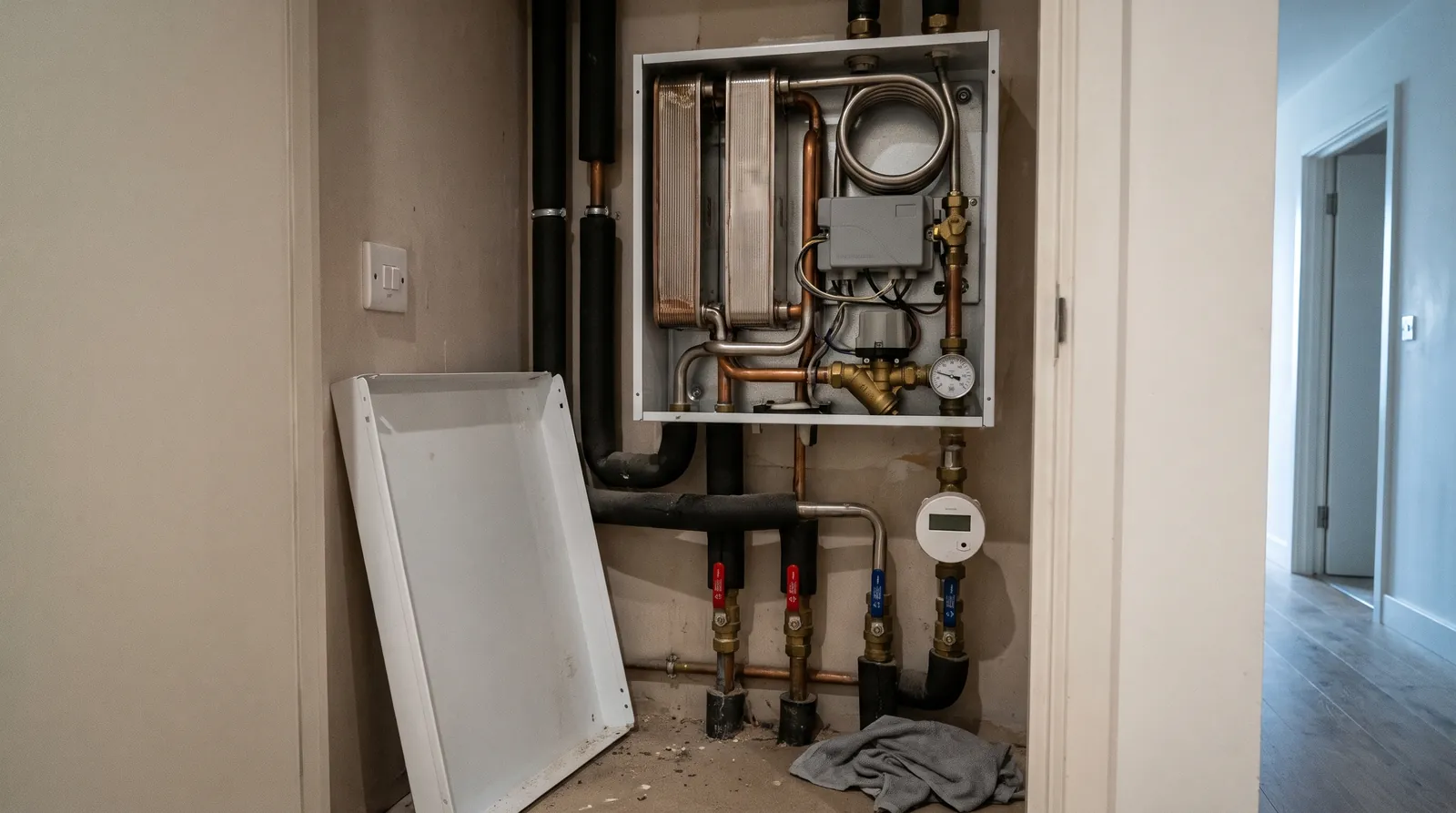
What does HIU stand for, and where will you find one?
HIU stands for heat interface unit. It sits at the meeting point between the heat network that serves the whole building and the heating system inside one home. In London you will find HIUs in most new-build blocks, build-to-rent schemes and many regenerated council estates, usually in a hallway or utility cupboard where a boiler would otherwise be. If your flat has underfloor heating, the HIU often sits in the same cupboard as the manifold.
How does a heat interface unit work?
An HIU works by passing heat across a metal plate, not by making heat. Hot water from the building's plant room (the "primary" side) flows up a riser and into the HIU. Inside, it passes one side of a plate heat exchanger, a stack of thin stainless-steel plates. The flat's own water (the "secondary" side) passes the other side and picks up the heat. The two waters never mix. Vital Energi's HIU guidance gives a typical example: network water at 60 to 95°C may produce secondary water of roughly 45 to 80°C.
In plain steps, this is what happens when a resident turns on a hot tap:
- A flow sensor in the HIU sees water moving on the hot water side.
- The controller opens a motorised valve on the network side.
- Network water flows through the hot water plate heat exchanger and warms the tap water as it passes.
- The valve modulates to hold the tap temperature steady, then closes when the tap shuts.
- The cooled network water goes back down the riser to the plant room to be reheated.
Heating works the same way through a second plate heat exchanger (or a direct connection on some designs), switched by the flat's thermostat.
What is inside an HIU?
Take the cover off a typical London HIU and you will see the same core parts whatever the brand:
- Plate heat exchangers: one for heating and one for hot water on most units.
- Strainer: a mesh filter that catches dirt from the network. It is the part that blocks most often.
- Control valves and actuators: they open and close to match demand.
- Differential pressure control valve: keeps the unit stable as pressure on the network changes.
- Controller and sensors: the electronics that read temperatures and flow.
- Safety relief valve, pressure gauge and expansion vessel on the flat's heating circuit.
- Heat meter: measures the heat each flat uses for billing. The Heat Network (Metering and Billing) Regulations 2014 require heat suppliers to install meters for each customer in many buildings with more than one customer.
Is an HIU the same as a boiler?
No. Both give a flat heating and hot water, but they get there in different ways. This is the comparison we give residents and managing agents:
| Heat interface unit (HIU) | Combi boiler | |
|---|---|---|
| Where the heat is made | Central plant room or district network | Inside the flat |
| Fuel in the flat | None; small electrical supply for controls | Gas |
| Flue and gas safety check | Not needed in the flat | Needed; annual gas safety check by Gas Safe registered engineers in rented homes |
| Hot water | Instant, via a plate heat exchanger | Instant, via the boiler's own heat exchanger |
| How it is billed | Heat meter, billed by the heat supplier | Gas meter, billed by the gas supplier |
| Who maintains it | Usually the landlord, managing agent or heat network operator | Usually the owner or landlord of the flat |
Is an HIU gas or electric?
Inside the flat, an HIU uses neither gas nor electricity to make heat. The heat is made centrally, by gas boilers, heat pumps or another source in the plant room or on a wider district network, and arrives as hot water. The HIU needs only a small electrical supply to run its controller and valves, which is why you will usually see a fused spur next to it.
Who is responsible for the HIU in a block of flats?
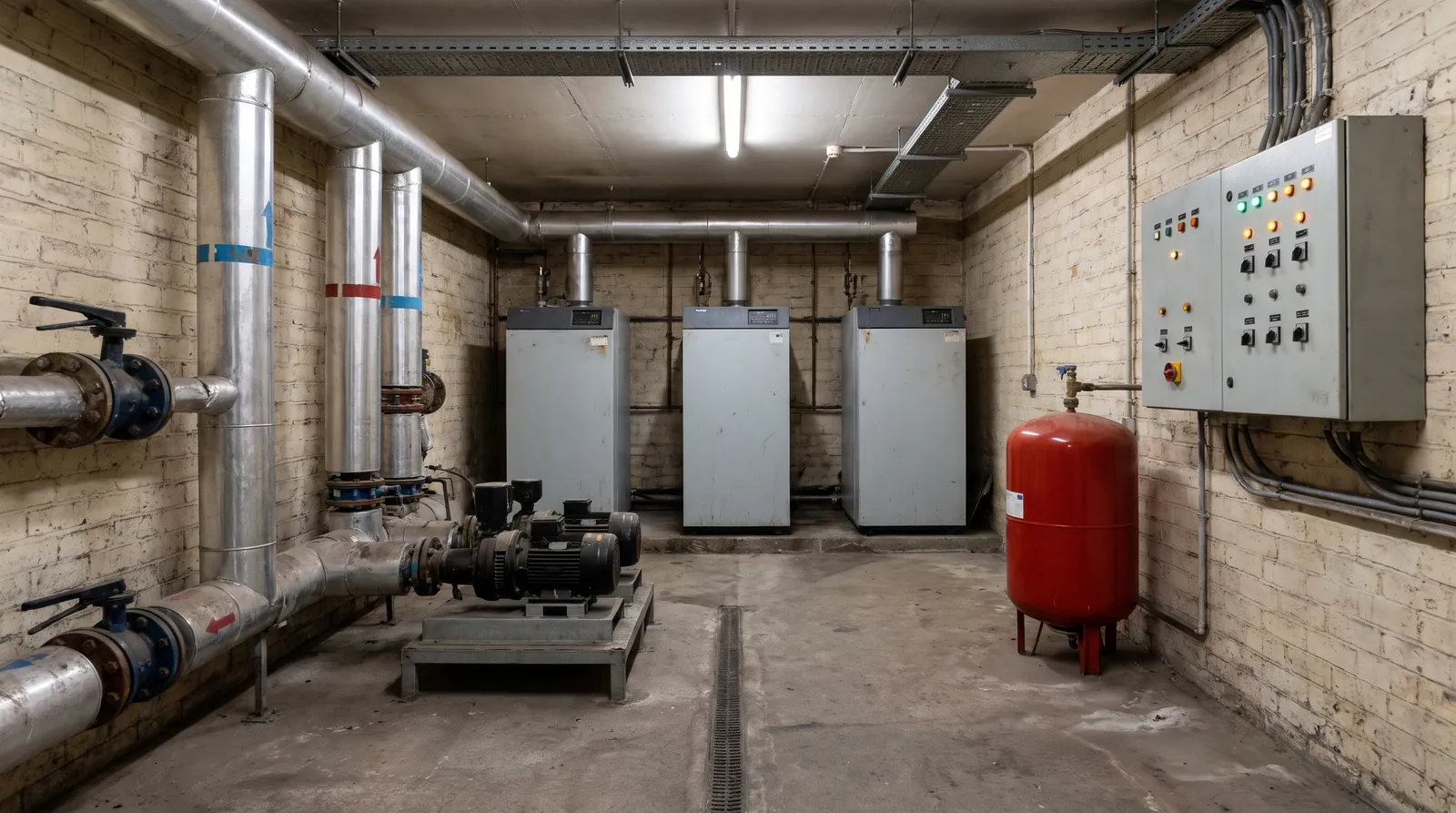
Usually the building owner, freeholder, managing agent or heat network operator is responsible, because the HIU is part of the communal heating system. But leases differ: some make the HIU part of the flat, so the leaseholder or their landlord pays for its servicing. The lease and the heat supply agreement settle it. Our HIU maintenance page sets out the common arrangements.
Responsibility now carries more weight. Ofgem became the regulator for heat networks in Great Britain on 27 January 2026, and existing networks must register with Ofgem by 26 January 2027. Our guide to heat network regulations for managing agents covers what that means. Plant room contracts often stop at the riser, so the HIUs inside flats are the part most often missed. A single heat network maintenance contract, or a block maintenance contract, closes that gap.
What does an engineer check on an HIU?
A proper visit is a set of measured checks, not a look under the cover. This is the checklist our engineers work through on each unit:
- Isolate the unit and clean the strainer, noting how much debris it held.
- Check the plate heat exchangers for scale, and test hot water temperature and flow at the tap.
- Test each control valve and actuator through its full travel.
- Check the differential pressure setting against the design.
- Check heating pressure, the expansion vessel and the safety relief valve.
- Read the heat meter and check it is recording and communicating.
- Look for leaks on every joint and isolating valve.
- Photograph the unit and record settings and findings in a per-flat report.
For how often this should happen, see how often an HIU should be serviced, and for the difference between a quick check and a full service, HIU inspection vs HIU service.
Why does HIU performance matter to the whole building?
Because every HIU sends its water back to the same plant room. A unit with a blocked strainer or a sticking valve returns water that is still too hot, and high return temperatures make the whole network less efficient. BESA runs the UK's HIU test regime, a voluntary test that measures, among other things, a unit's volume weighted average return temperature (VWART), because low return temperatures are what a good HIU delivers. For residents, the first sign of a neglected unit is usually lukewarm or slow hot water; our guide to no hot water on communal heating walks through the causes.
Getting HIUs looked after in your building
Mainteniq services, repairs and inspects heat interface units across London and the Home Counties. Our engineers hold SAV Advanced HIU Service Engineer certification, are SAV and Danfoss manufacturer approved and Evinox trained and certified, and work on every major brand. We have worked in buildings such as Battersea Power Station and Embassy Gardens. HIU servicing is priced per unit, and booking the flats in one block together lowers the cost per flat. Contract clients also get our 24/7 emergency line.
See what a visit covers on our HIU maintenance service page, or ask for a quote for your block.
Sources
- Vital Energi, What is a heat interface unit? (vitalenergi.co.uk)
- The Heat Network (Metering and Billing) Regulations 2014, SI 2014/3120, regulation 4 (legislation.gov.uk)
- BESA, Heat interface units: the UK test regime (thebesa.com/heating-interface-units)
- Ofgem, Heat networks regulation timeline and who should register (ofgem.gov.uk)
Related services & guides
Talk to a London maintenance specialist
Whether it's one property or a portfolio, we'll put your compliance and servicing on a single planned maintenance contract. Get a no-obligation quote.