2-Pipe vs 4-Pipe Fan Coil Units: What Is the Difference?
Why can some flats cool on a warm April afternoon while the flat next door only blows warm air? Usually it comes down to how many pipes feed the fan coil unit. Here is the difference, and what it means for comfort, running costs and servicing.
Direct answer: a 2-pipe fan coil unit has one coil that gets either hot or chilled water, depending on what the whole building is set to that season. A 4-pipe unit has two coils, one for hot water and one for chilled water, so every room can heat or cool on any day. 4-pipe gives more control; 2-pipe is simpler and cheaper.
How a 2-pipe fan coil unit works
A 2-pipe unit has one flow pipe, one return pipe and a single coil. The building's plant decides what goes down those pipes: hot water in the heating season, chilled water in the cooling season. The switch, called changeover, is made for the whole building at once, usually in spring and again in autumn.
How a 4-pipe fan coil unit works
A 4-pipe unit has two coils side by side in the same casing: a heating coil on the hot water circuit and a cooling coil on the chilled water circuit. Each has its own flow pipe, return pipe and motorised valve. Hot and chilled water are available all year, and the room controller opens whichever valve it needs.
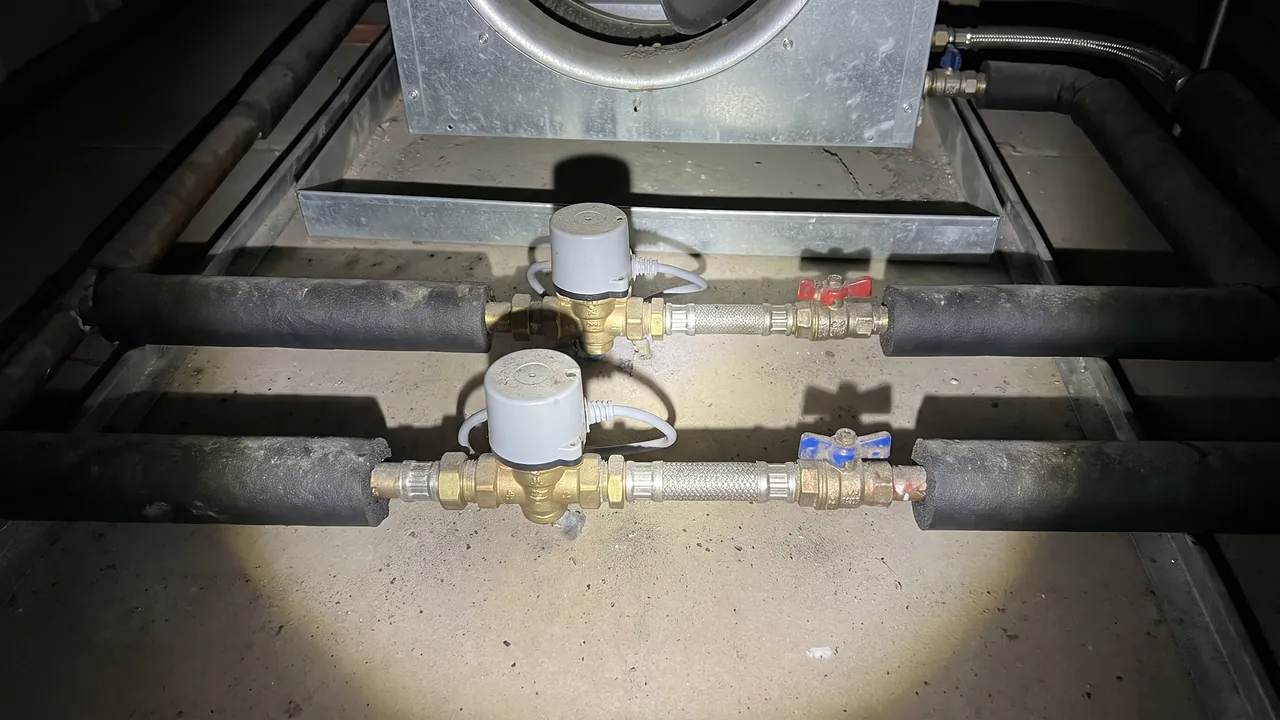
2-pipe vs 4-pipe at a glance
| 2-pipe | 4-pipe | |
|---|---|---|
| Coils in the unit | One | Two: heating and cooling |
| Pipes to the unit | Flow and return | Two flows and two returns |
| Heat or cool any day | No, the building is in one mode | Yes, each room chooses |
| Comfort in spring and autumn | Often poor | Good |
| Install cost | Lower | Higher |
| Valves and actuators to maintain | One set | Two sets |
| Main energy risk | Changeover at the wrong time | Heating and cooling valves open together |
| Typical London use | Older offices, some residential blocks | Modern offices, hotels, high-specification flats |
How to tell which one you have
You can usually tell in a minute with the ceiling access hatch open and a torch:
- Count the insulated pipes going into the unit. Two pipes means 2-pipe; four means 4-pipe.
- Count the motorised valves, the small grey or black heads on top of brass valves. One means 2-pipe; two means 4-pipe.
- Check the controller. If it can heat on a cold morning and cool the same afternoon, it is almost certainly 4-pipe.
- Read the operation and maintenance manual or ask the managing agent. It will name the system.
Some buildings feed the cooling coil through a cooling interface unit and the heating coil through a heat interface unit in the same flat, so the pipe count can include connections to those too.
The hidden fault on 4-pipe units: heating and cooling at once
The flexibility of a 4-pipe unit has a cost. If the heating valve does not shut fully, or an actuator sticks, hot water passes through the heating coil while the cooling coil is trying to cool. The room may still feel fine, because the controller simply opens the cooling valve further, but the building pays twice: once to heat the water and once to chill it away. Nobody complains, so it can run like this for years.
What we check: on every 4-pipe unit our engineers drive each valve open and shut, check that the coil it serves goes cold or warm as expected, and record any valve that passes water when closed. On buildings with a BMS, the trend logs often show the same problem across a whole floor.
What each type needs at a service
See the full step-by-step list in how a fan coil unit is serviced.
What about 3-pipe systems?
A 3-pipe system has separate hot and chilled flow pipes but one shared return. Mixing warm and cold water in that return wastes energy, so 3-pipe systems are now rare in UK buildings and are usually converted when a floor is refurbished. If you have one, it is worth a survey before any major work.
Getting your fan coil units checked
Mainteniq services 2-pipe and 4-pipe fan coil units in London flats, build-to-rent blocks, hotels and offices, with a photographed report for every unit and per-unit pricing that drops when a floor or block is booked together. If your units are worn rather than broken, see fan coil unit refurbishment; for everything else, our FCU maintenance page.
Sources
- CIBSE TM43: Fan coil units (cibse.org)
- BESA, SFG20 maintenance specification (sfg20.co.uk)
Related services & guides
Talk to a London maintenance specialist
Whether it's one property or a portfolio, we'll put your compliance and servicing on a single planned maintenance contract. Get a no-obligation quote.