What Is a Fan Coil Unit (FCU)? How It Works, Types and Upkeep
If your flat or office has grilles in the ceiling and a small controller on the wall, but no radiators and no air conditioning box outside, the heating and cooling almost certainly come from a fan coil unit. Here is what it is, how it works and how it is kept running.
Direct answer: a fan coil unit (FCU) is a fan, a filter and one or two water coils inside a metal casing. Hot or chilled water from the building's central plant flows through the coils, the fan blows room air across them, and the room is heated or cooled to its own setting. In London flats, hotels and offices most FCUs are hidden in the ceiling void and blow air out through grilles.
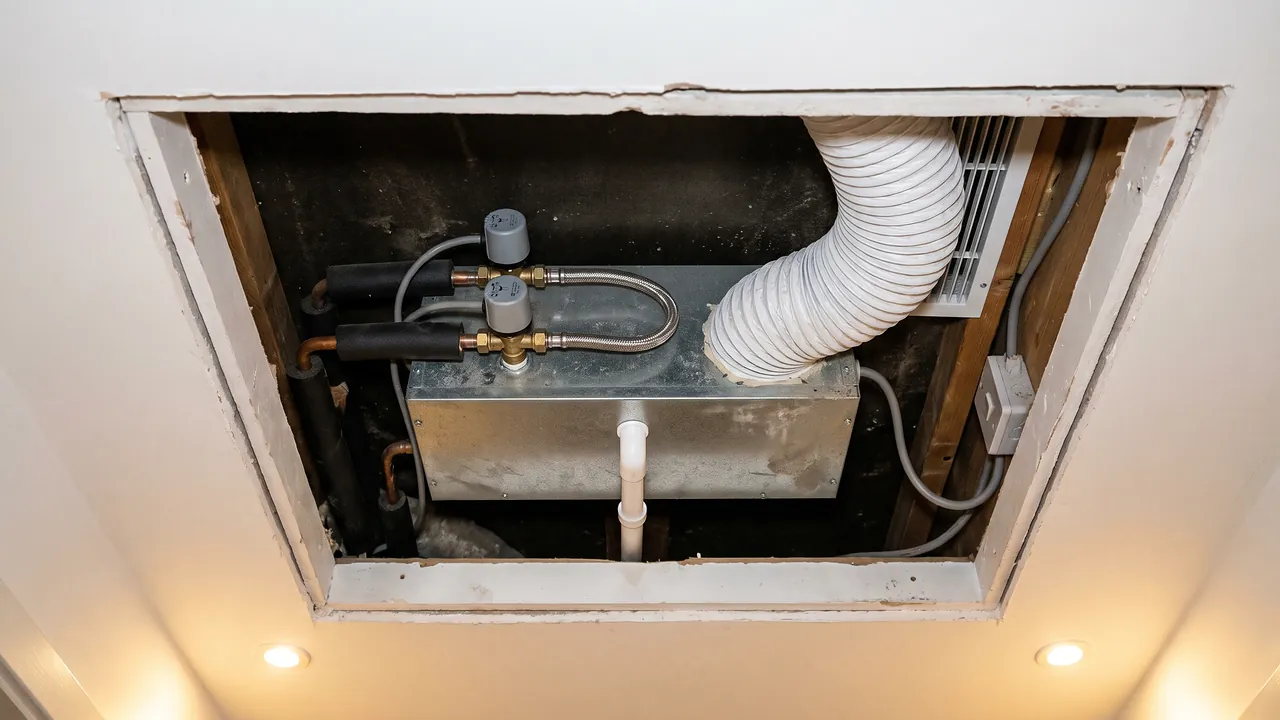
What does FCU stand for?
In heating and air conditioning, FCU stands for fan coil unit. The name lists its two working parts: a fan that moves air, and a coil that heats or cools it. If you searched for FCU after an electrician mentioned one, they probably meant a fused connection unit, the switched or unswitched fused spur that powers a fixed appliance. A fan coil unit is often wired to one, which is where the two meet.
How does a fan coil unit work?
A fan coil unit does not make heat or cold itself. It borrows it from water that has already been heated or chilled centrally, by boilers, a heat pump, a heat network or a chiller. Every FCU works through the same five stages:
Because the water is shared and the control is local, one central plant can serve hundreds of rooms while each tenant, guest or office team chooses their own temperature. That is why FCUs are so common in London's new-build towers, build-to-rent blocks, hotels and offices.
What is inside a fan coil unit?
Take the bottom panel off almost any fan coil unit and you will find the same parts, whatever the make:
| Part | What it does | What goes wrong |
|---|---|---|
| Filter | Catches dust and fluff from the room air | Clogs, cutting airflow and letting dirt reach the coil |
| Coil (or two coils) | Finned copper pipe that carries hot or chilled water | Fins fill with dust; old coils can corrode and leak |
| Fan and motor | Moves air across the coil; EC motors allow fine speed control | Noise, worn bearings, a failed motor or EC module |
| Drip tray and condensate drain | Collects water from the cooling coil and drains it away | Sludge blocks it and water comes through the ceiling |
| Valves and actuators | Open and close the water to each coil | Sticking valves, failed actuators: no heat or no cooling |
| Controller | Reads the room temperature and runs the fan and valves | Wrong settings, lost BMS signal, failed sensor or board |
What types of fan coil unit are there?
Fan coil units are grouped by where they sit and whether you can see them. These are the types our engineers meet most in London buildings:
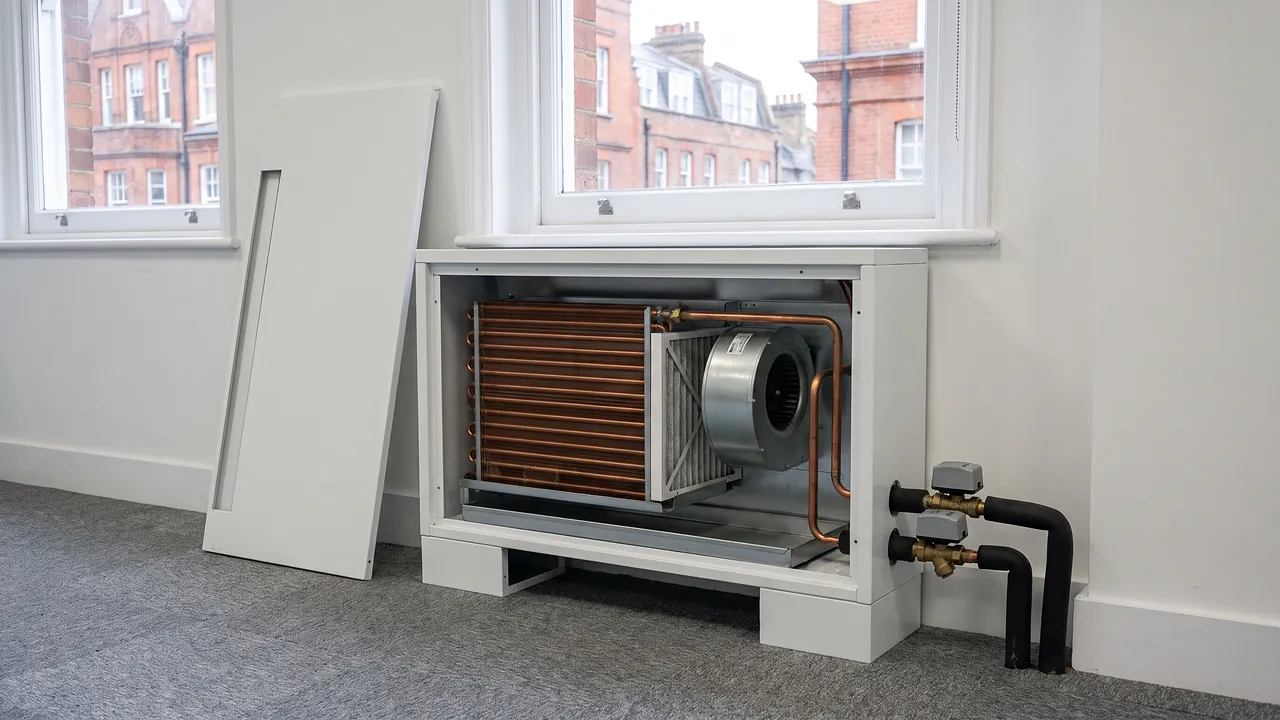
What is the difference between a 2-pipe and a 4-pipe fan coil unit?
The pipe count tells you whether a unit can heat and cool at the same time of year.
| 2-pipe | 4-pipe | |
|---|---|---|
| Coils | One coil | Two coils, one for heating and one for cooling |
| Water supply | Hot or chilled water, switched over by season | Hot and chilled water available all year |
| Heat and cool on the same day | No; the whole building is in one mode | Yes; each room chooses |
| Valves to check | One valve set | Two valve sets |
Our full guide on 2-pipe vs 4-pipe fan coil units explains changeover, how to tell which one you have, and what each needs at a service.
Fan coil unit, split air conditioning or VRF: what is the difference?
All three can blow cool air from a ceiling grille, so they are easy to mix up. The difference is what flows through the coil:
| Fan coil unit | Split air conditioning | VRF indoor unit | |
|---|---|---|---|
| What runs through the coil | Hot or chilled water | Refrigerant | Refrigerant |
| Where the cold is made | A chiller or heat pump in the plant room | An outdoor unit for that system | Shared outdoor units on the roof |
| Refrigerant in the room | No | Yes | Yes |
| F-Gas certified engineer needed | Not for the FCU itself | Yes | Yes |
| Typical London building | New-build towers, BTR, hotels, offices | Single flats, shops, server rooms | Offices, hotels, mixed-use blocks |
Mainteniq holds REFCOM company F-Gas certification (REF1024168), so we look after both the water-based fan coils and the refrigerant systems in the same building. See our air conditioning and HVAC maintenance pages.
Fan coil units in London blocks of flats
In a modern residential tower an FCU rarely works alone. A typical flat has:
When the flat is too hot or too cold, the fault can sit in any of the three, or in the building management system that runs them. That is why we service them together: see what is a heat interface unit, our CIU maintenance page and Titan Products controls, common in London apartment blocks.
How is a fan coil unit looked after?
An FCU has no flame and few moving parts, so it is easy to forget until water comes through the ceiling. Most problems come from three neglected jobs:
- Filters left to clog, which starves the unit of air and lets dust coat the coil.
- Drip trays and condensate drains left to fill with sludge, the usual cause of a leak in the room below.
- Valves and controls never tested, so a stuck valve only shows up on the first hot or cold day.
CIBSE TM43 is the UK guidance on fan coil units, and SFG20 is the maintenance specification most contracts are written to. Our step-by-step guide on how a fan coil unit is serviced sets out what a proper visit covers, and fan coil unit problems explains what each symptom usually means.
Who is responsible for a fan coil unit in a block?
The lease decides. In many London blocks the FCU inside a flat belongs to the flat, so the leaseholder or their landlord pays for its servicing and repair. The hot and chilled water pipes, risers and plant room belong to the building and are looked after by the managing agent or freeholder. Tenants should report a fault to their landlord or letting agent first. Many managing agents book one programme for every flat so access is organised once and each flat gets its own report.
Getting fan coil units looked after in your building
Mainteniq services, repairs and refurbishes fan coil units in flats, build-to-rent blocks, hotels and offices across London and the Home Counties. Every unit gets a photographed report, servicing is priced per unit with lower rates when a floor or block is booked together, and contract clients have our 24/7 emergency line. Where the units are worn rather than broken, see fan coil unit refurbishment.
See what a visit covers on our FCU maintenance service page, or ask for a quote for your building.
Sources
- CIBSE TM43: Fan coil units (cibse.org)
- BESA, SFG20 maintenance specification (sfg20.co.uk)
- GOV.UK, F gas: guidance for users, producers and traders (gov.uk)
Related services & guides
Talk to a London maintenance specialist
Whether it's one property or a portfolio, we'll put your compliance and servicing on a single planned maintenance contract. Get a no-obligation quote.